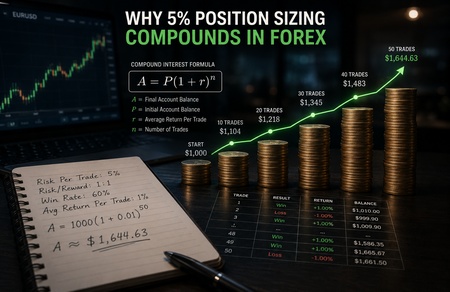
Every time I open a trade, jMathFx automatically allocates exactly 5% of my current account balance. Not 5% of the initial...
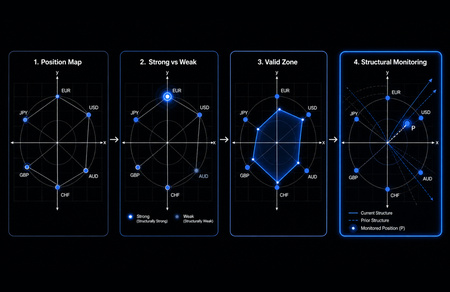
Describing a mathematical approach to forex trading in abstract terms is easy. Describing what it actually looks like, step by step, from market observation to position decision, is less common....
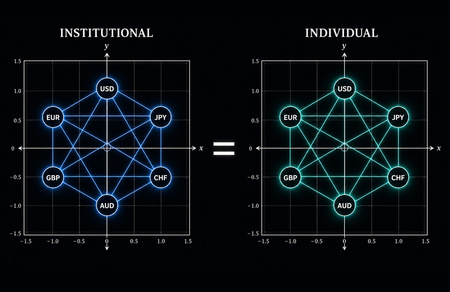
There is a structural difference between how institutional forex desks analyze the market and how retail traders analyze it. It is not a difference of technology, experience, or capital. It is a...
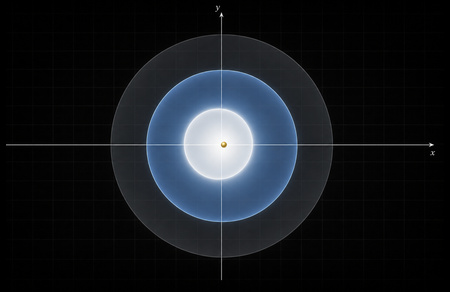
Every indicator in the standard forex toolkit is an attempt to measure something about price behavior. Momentum, trend strength, overbought and oversold conditions, volatility. These are useful...
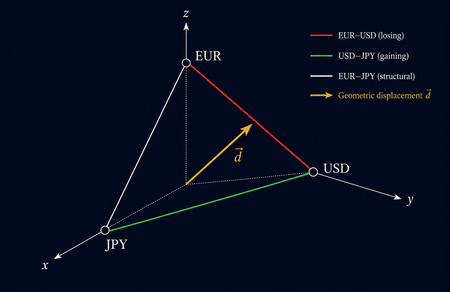
A losing position in forex is typically managed in one of two ways: absorb the loss by closing, or hold and hope for reversal. Both approaches treat the position in isolation, as if the pair you...
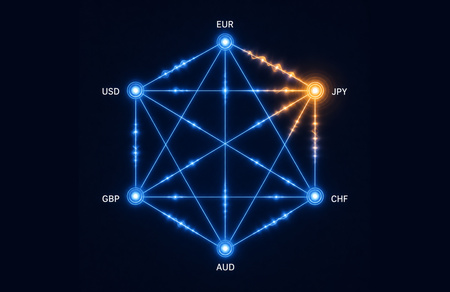
Risk management in retail forex is almost entirely probabilistic. The question is always some version of: given historical behavior, what is the likely size of an adverse move, and how much...
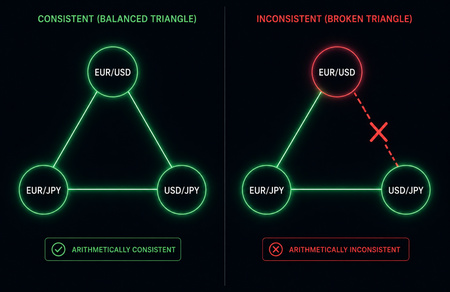
A forex forecast that covers more than one currency pair must satisfy a condition that almost no forecasting tool addresses: algebraic consistency. Without it, the forecast is not merely...
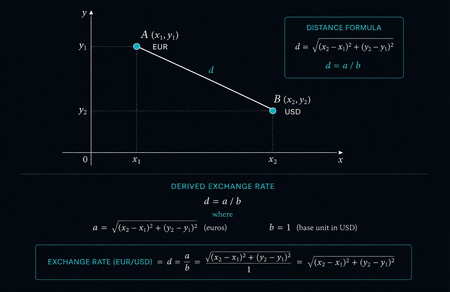
The statement that the distance between two points on a Cartesian plane equals an exchange rate sounds like a simplification. It is not. It is a precise mathematical statement, and the proof...
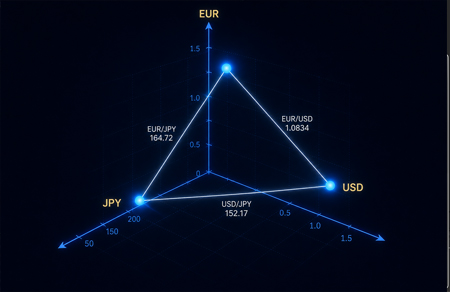
Geometry is not a metaphor for the forex market. It is the actual structure of the forex market. This distinction matters because as long as traders treat geometric language as illustrative rather...
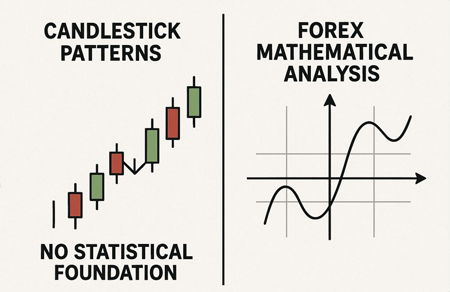
Ask a trader why they entered a position and there is a reasonable chance the answer involves a candlestick pattern. A hammer at support. An engulfing candle at resistance. A doji at a...
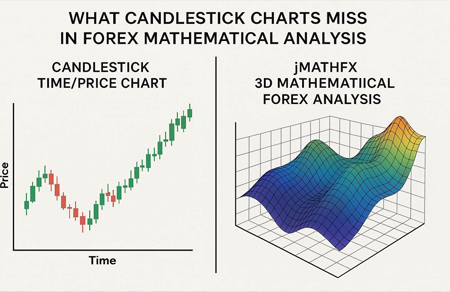
The candlestick was invented in eighteenth-century Japan to track rice prices. It records four data points: the opening price, the closing price, the high and the low within a given time...

A trader opens a EUR/USD time/price chart. The price moves. The trader looks for a reason on that same chart: a support level, a pattern, a moving average. The actual cause of the...
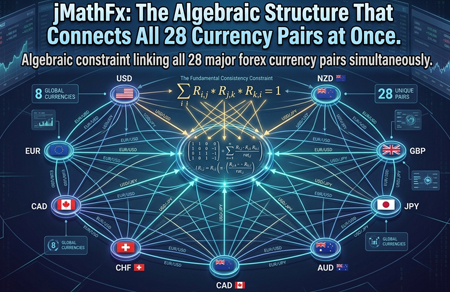
There are eight major currencies in the forex market. From these eight currencies, 28 tradeable pairs are derived. Most traders treat these 28 pairs as a menu. They pick one, open a...

The efficient market hypothesis says prices move randomly. Decades of academic research have been built on this assumption. Entire trading philosophies depend on it. There is one...
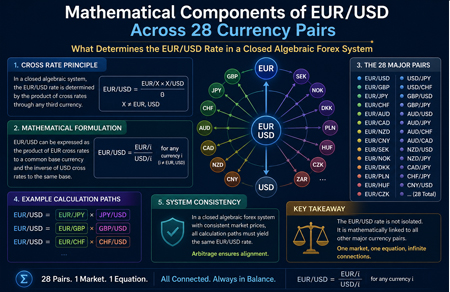
Most traders treat EUR/USD as a price. Something that goes up or down based on news, sentiment, central bank decisions, or the pattern on a candlestick chart. This is not wrong. It is...
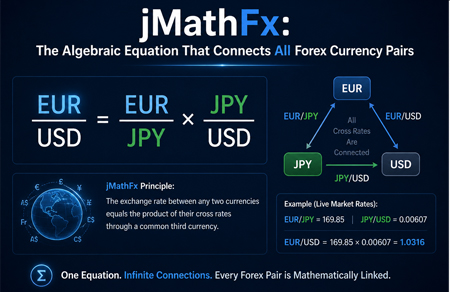
There is one equation that governs every exchange rate on the planet. It has been true since the first currency pair was quoted. It will be true tomorrow. It cannot be arbitraged away,...
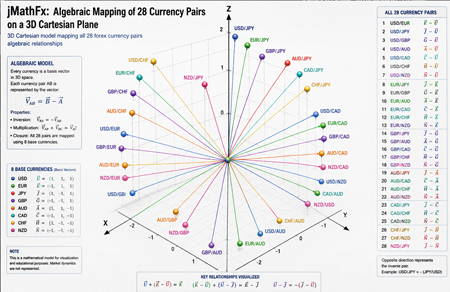
Every trader opens a chart. EUR/USD. One pair, one screen, one decision.
It feels logical. It feels complete. It is neither.
The forex market is...
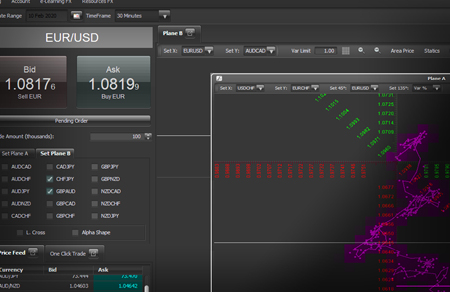
3D Forex Mapping
The Cartesian Plane Representation is a groundbreaking visualization tool within the jMathFx platform, designed to map...

In the world of trading, the art of reinvesting gains plays a crucial role in determining overall profitability. However, the key lies not only in reinvesting...
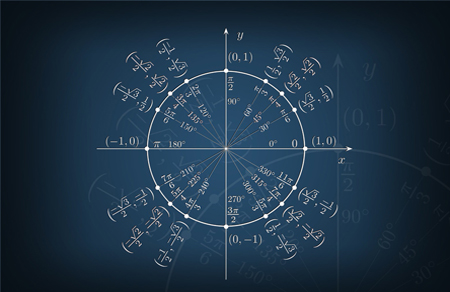
In the complex and dynamic world of the forex market, the presence and importance of mathematics emerge as crucial and fundamental elements. It is a unique market where mathematics not only plays...

Financial markets originated in the last century, and the practical theories we know today largely developed through a similar method. But how do these theories...