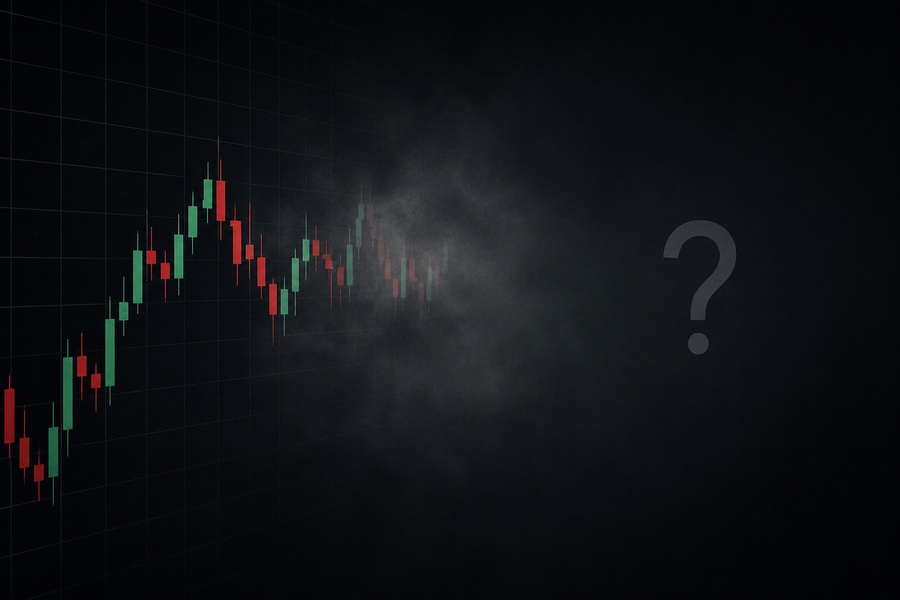
More than 90% of retail traders lose capital in the long run. In any other technical field, a systematic failure rate of that magnitude would trigger an immediate review of the fundamental tools in use. If bridges built by 90% of engineers collapsed, no one would blame the engineers psychology. They would look at the blueprints.
In trading, the industry has built a different narrative: if you lose, it is your fault. You lack discipline. Your psychology is poor. You did not study enough.
I want to propose a different explanation. The problem is not the operator. The problem is the map.
To understand what is wrong with the standard candlestick chart, it helps to define it mathematically. A chart, whether candlestick, bar, or line, is plotted on a two-dimensional Cartesian plane where the horizontal axis is time and the vertical axis is price. This is a graphical representation of the function:
$$p = f(t)$$
Notice what this function does not describe. It records when a price was occupied. It explains nothing about why that state occurred or whether it is sustainable. The chart is a historical log, not a structural model.
Because time flows in only one direction, the chart forces every observer to focus on how price changes relative to time. The trader's brain is not actually reading price levels. It is reading the rate of change:
$$v = \frac{dp}{dt}$$
This is what the trading industry calls trend, momentum, or strength of the move. What it actually is, is velocity. And here is the paradox: velocity is not a cause. It is an effect. It is a retrospective calculation of an equilibrium that has already been resolved.
By the time a fast move appears on your chart, the force that caused it has already acted. You are looking at a footprint, not the animal that made it. Decisions based on historical derivatives mean working with exhausted information.
Confronted with this limitation, traders are taught a workaround: use multiple timeframes. Look at the daily chart for direction, then drop to the 4-hour for entry, then the 1-hour for precision.
But because time does not actually participate in determining currency values, changing the timeframe introduces no new variables. It resamples the same single variable at a different resolution. The result is what I call the Matryoshka Effect: visual self-similarity across scales, like Russian nesting dolls.
Open a daily candle and inside you find the same structural shapes on the hourly. Open the hourly and find the same on the 5-minute. Each timeframe looks analytically distinct but is mathematically identical in what it can tell you. This creates an illusion of depth that has cost traders years of wasted analysis. For more on this, see Hidden Risks in the Self-Similarity of Forex Candlestick Charts.
A system can only be improved if errors are diagnosable. When an engineer designs a bridge that fails, they can return to the calculations, identify the flawed parameter, and correct it. The process is learnable because the error is visible.
In traditional trading, error is invisible. When a trade hits your stop-loss, the time/price chart tells you only that price went somewhere else. It does not show which systemic forces prevailed, which relationships shifted, which structural boundary was violated.
The reason is structural. Because the future area of the chart is empty space, every decision was made in a complete informational void. The subsequent loss cannot be traced to a specific misread variable because no variable was being read at all. Only the shadow of one.
A system that does not make error diagnosable is, by definition, a non-learnable system. Experience in this context does not build genuine competence. It builds the appearance of competence.
The exit from this loop requires removing time from the observation plane entirely. If an exchange rate is a ratio of reciprocity between two currencies, then the correct plane of observation is one that maps price relative to price, not price relative to time. This is the shift from $p = f(t)$ to $p_1 = f(p_2)$. The article Price Against Price: Mapping Forex Dynamics on a Relational Cartesian Plane explains how this works in practice.