
Retail traders operate under the illusion that any currency pair can move to any price level at any time. This assumption is mathematically false. The exchange rates of the 28 major pairs are bound by algebraic limits. These limits mean that price movements are constrained by the state of the surrounding network. I derive these limits algebraically to locate structural corrections.
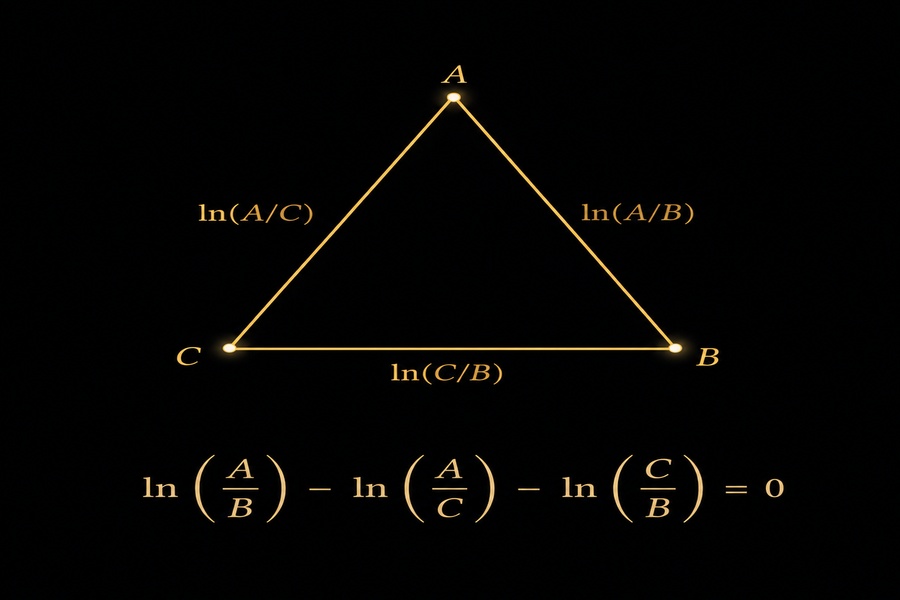
Consider a currency triad composed of EUR, USD, and JPY. The exchange rates of these pairs must satisfy the cross-rate equation:
ln(EUR/JPY) - ln(EUR/USD) - ln(USD/JPY) = 0
If this sum is not zero, the system is in an inconsistent state. Because modern institutional transaction routing is automated, any deviation is resolved in milliseconds by arbitrage flows. The exchange rates cannot drift independently. The algebraic limits of the triad dictate that a movement in one pair must trigger a proportional movement in the remaining pairs.
By mapping these algebraic limits on the Cartesian plane, I calculate the boundary constraints of any currency triad. When the coordinates of EUR/USD and USD/JPY move, they define the exact range of allowed values for EUR/JPY.
If the market pushes EUR/JPY towards the edge of this range, it experiences structural resistance. You do not need to forecast trend strength. You can derive the mathematical limit where the movement must cease. This spatial analysis replaces probabilistic predictions with algebraic calculation. Stop guessing. Calculate the boundaries.
Related reading: The Constraint That Links All 28 Fx Pairs