
Currencies don't float because of news headlines or Twitter rumors. They float because of massive global trade flows. The Balance of Payments (BoP) is the macroeconomic ledger that dictates long-term exchange rate trajectory. Speculators ignore this data at their own peril. The structural equation is simple double-entry bookkeeping.
The Balance of Payments is composed of three primary accounts: the Current Account (recording trade in goods and services), the Capital Account (recording intangible assets), and the Financial Account (recording investments and capital flows). The fundamental rule of double-entry bookkeeping dictates that the sum of these accounts must be zero:
Current Account + Capital Account + Financial Account = 0
If a country runs a current account deficit (importing more than it exports), it must finance this deficit through a financial account surplus (attracting foreign investment or borrowing). If foreign capital inflows are insufficient, the central bank must use its reserves or allow the currency to deflate. This structural requirement is what drives long-term exchange rate movements. It is a hard constraint that speculators ignore at their own risk.
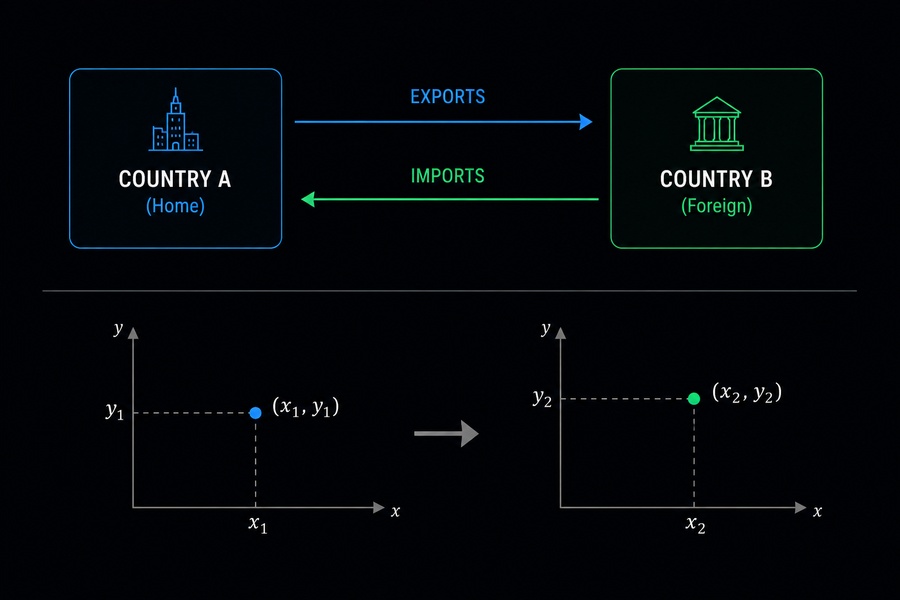
In coordinate space, the Balance of Payments represents a force vector that displaces currency coordinates. A trade deficit acts as a downward force, dragging the coordinate value lower, while a financial surplus acts as an upward force.
By mapping these BoP vectors on the Cartesian plane, I identify which currencies are experiencing structural stress. This spatial analysis allows you to evaluate long-term currency trajectories based on macroeconomic data rather than simple chart patterns. Stop drawing random lines and track the flow of real money.
Related reading: Inflation and Monetary Illusion: Unraveling the Secrets that Shape the Economy