
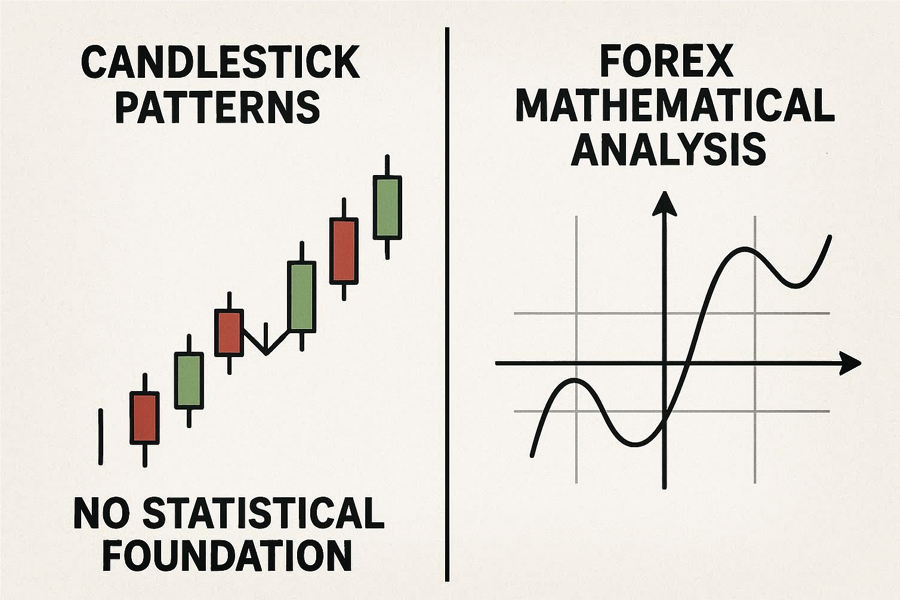
Ask a trader why they entered a position and there is a reasonable chance the answer involves a candlestick pattern. A hammer at support. An engulfing candle at resistance. A doji at a key level. These descriptions are everywhere in trading education. What is almost never discussed is whether they work, measured statistically, across a large enough sample to be considered evidence of anything.
The studies that have attempted to answer this question are not encouraging. Across multiple markets, multiple timeframes and multiple pattern types, candlestick patterns do not produce statistically significant results above random chance. Some show modest positive results in specific conditions. Most do not survive rigorous testing. None produce the kind of consistent, reproducible edge that would be required to call them a reliable analytical method.
This is not surprising once you understand what a candlestick pattern actually is. It is a visual description of how price behaved within one or more time intervals on a time/price chart. It carries no information about why price behaved that way, what algebraic forces produced the movement, or whether the movement is consistent with the rest of the 28-pair system. A hammer on EUR/USD looks the same whether it was produced by a genuine shift in Euro strength or by a mechanical adjustment in USD/JPY propagating through the system. The pattern cannot distinguish between the two. The math can.
The fundamental issue is that candlestick patterns were developed through visual observation of price behavior on time/price charts. They were never derived from the mathematical properties of the market itself. They describe what price did. They say nothing about what price was algebraically required to do. These are entirely different things, and confusing them is the reason pattern-based analysis produces inconsistent results even in the hands of experienced traders.
A method derived from the algebraic structure of the forex market operates differently. It does not ask what this price bar looks like. It asks what the entire 28-pair system requires at this moment. The answer is not a pattern. It is a constraint. Constraints do not depend on visual interpretation. They are either satisfied or they are not. When they are not, the market moves to satisfy them. That movement is calculable before it happens.
jMathFx was built on this principle. The platform does not generate patterns. It maps the algebraic state of all 28 currency pairs simultaneously on a three-dimensional Cartesian model and makes the constraints of the system visible in real time. What you see is not a sequence of bars waiting to form a recognizable shape. It is a geometric structure with mathematical properties that determine the range of possible next states.
Patterns are what you look for when you do not have access to the math. When you do, you stop looking for patterns entirely. Start at jMathFx.com.