
The statement that the distance between two points on a Cartesian plane equals an exchange rate sounds like a simplification. It is not. It is a precise mathematical statement, and the proof behind it is the foundation on which the entire jMathFx analytical framework is built.
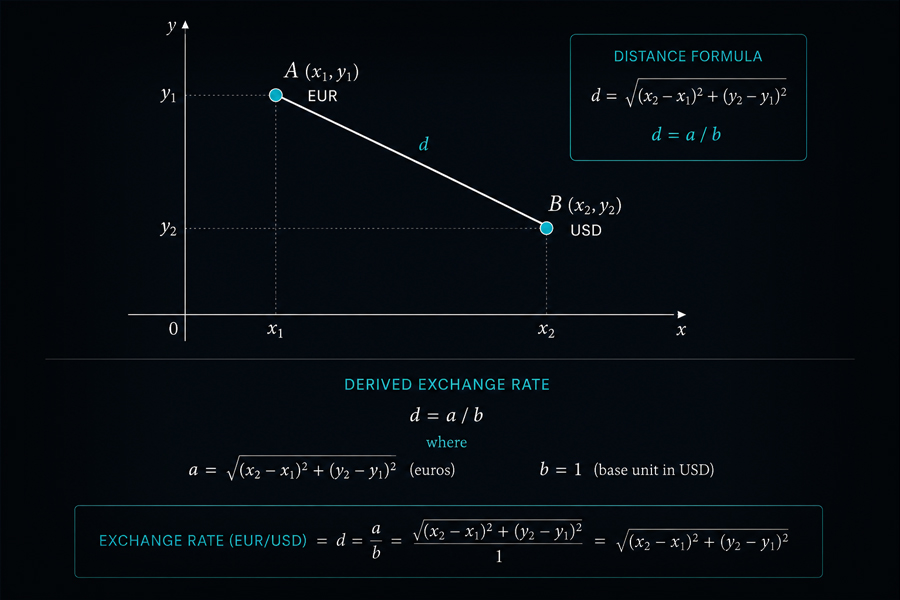
Start from the definition. In a Cartesian coordinate system, each axis represents a currency. A currency is assigned a coordinate value. That value represents its purchasing power relative to a reference point. The exchange rate between two currencies is the ratio of their coordinate values. Not an approximation of that ratio. The exact ratio, by definition.
From this, the distance between two currency positions in the coordinate system follows directly. If currency A has coordinate value a and currency B has coordinate value b, then the exchange rate A/B is the ratio a/b. On the Cartesian plane, the geometric relationship between the positions of A and B at those coordinates encodes the same ratio. The distance is not a separate quantity that happens to resemble the exchange rate. It is the exchange rate, expressed geometrically.
The analytical consequence of this is not trivial. If exchange rates are distances in coordinate space, then every property of geometric distances applies to exchange rates. Distances must be consistent with each other. If you know the distance from A to B and the distance from B to C, the distance from A to C is constrained. It cannot take an arbitrary value. The triangle inequality and the Pythagorean relationships in the coordinate system impose hard limits on which combinations of exchange rates can coexist.
Traditional time/price charts represent none of this. A bar on a time/price chart shows a price level at a point in time. It does not represent the coordinate position of a currency in a system. It does not encode the geometric relationships between that currency and the other seven major currencies. It does not expose the distance constraints that follow from the coordinate model. The chart shows the output of the geometry without the geometry itself.
When you work with a Cartesian model of the forex market, the geometry is the model. Every exchange rate is a distance. Every movement is a displacement in coordinate space. Every constraint on future prices is a geometric constraint on distances in that space. The analytical information contained in a Cartesian model is structurally different from, and greater than, anything available on a time/price chart.
The jMathFx Platform is built on this geometric foundation. See the market as distances and positions at jMathFx.com.