
Risk management in retail forex is almost entirely probabilistic. The question is always some version of: given historical behavior, what is the likely size of an adverse move, and how much capital should be at risk? This framework is borrowed from statistics. It treats the market as a generator of random outcomes with measurable distributional properties.
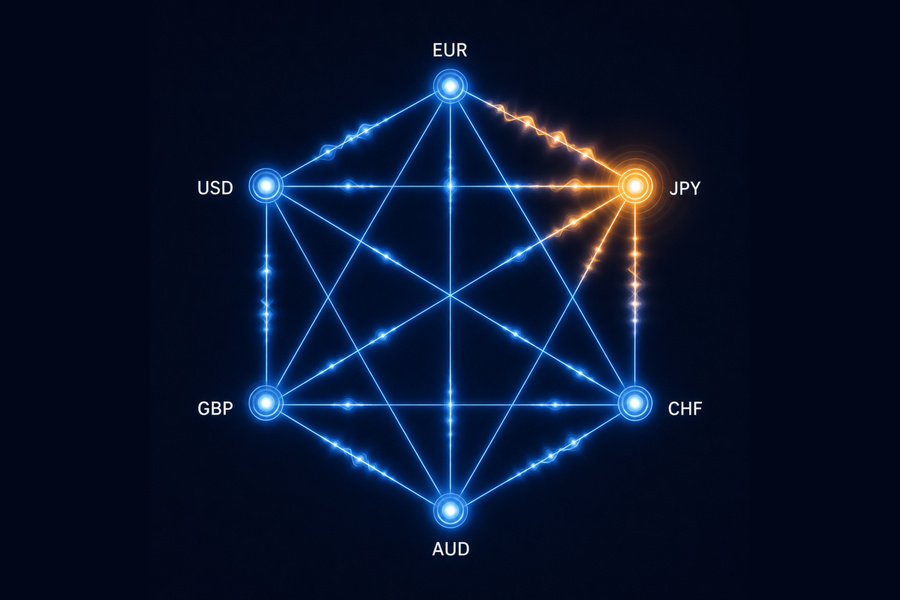
A closed algebraic system produces a different kind of risk. Not random risk, but structural risk. The difference is not semantic. In a system where all 28 exchange rates are algebraically related, an open position in one pair is simultaneously an exposure to the algebraic constraints that all other related pairs impose on that pair.
Consider a long EUR/USD position. In the time/price framework, the risk is the probability that EUR/USD moves against the trade. In the algebraic framework, the risk includes the specific structural conditions under which EUR/USD must move against the trade. If EUR is losing coordinate position across the system, the movement in EUR/USD is not an independent random event. It is a geometric consequence of a broader structural shift. That shift is visible in the model before it fully propagates to the pair you are watching.
This changes risk measurement from statistical estimation to geometric observation. Instead of asking what the historical volatility of EUR/USD implies about the probable size of adverse moves, you ask what the current coordinate positions of EUR and USD imply about the structural pressure on the pair. These are not the same question, and they do not produce the same answer.
The practical consequence is that in an algebraic framework, risk can be partially anticipated through the geometry of the system rather than estimated from historical distributions. A structural imbalance that places strong pressure on a currency is observable before the rate reflects it fully. A statistical model sees the move only after it begins. A geometric model sees the pressure before the move materializes.
Traditional risk management tools were not designed for a closed algebraic system. They were designed for statistical processes. Applying them to a system that has a precise algebraic structure means discarding information that the structure contains. The jMathFx Platform is built to make that structural information available. Explore it at jMathFx.com.