
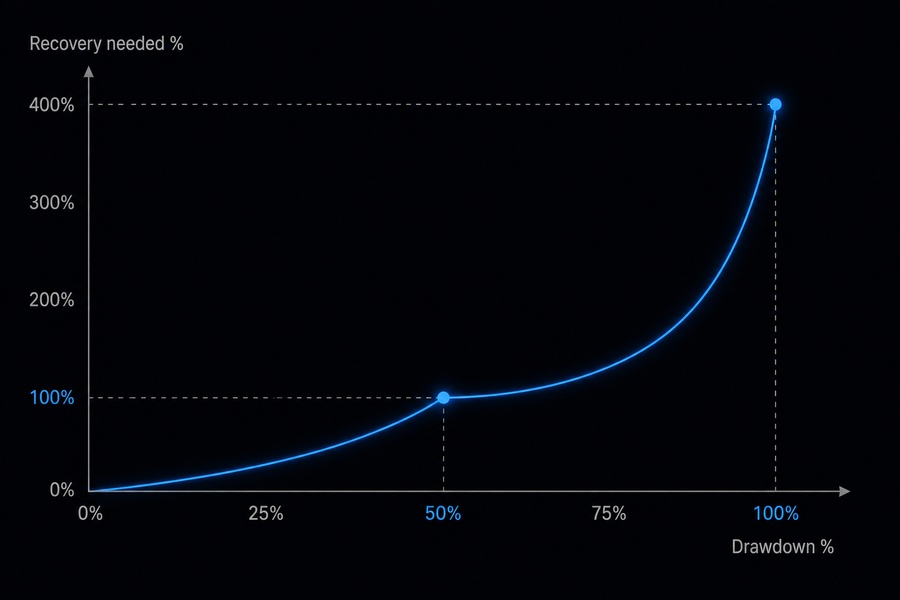
Let's talk about the math of losing. Most retail traders think about risk as a linear game. They lose 10% and think they just need to make 10% back. They lose 50% and think a 50% gain gets them even. This is a massive mathematical delusion. The math of drawdown is brutal and non-linear. I look at this curve to protect my capital before it's too late.
When you lose capital, the remaining balance is smaller. To recover to your initial balance, the percentage gain must be calculated on this smaller base. The formula for the required recovery gain R after a drawdown percentage D is:
R = D / (1 - D)
Let us look at the numbers. If you experience a 10% drawdown, you need an 11.1% gain to recover. If you experience a 30% drawdown, you need a 42.8% gain. If you experience a 50% drawdown, you need a 100% gain. If you experience a 90% drawdown, you need a 900% gain.
As drawdown increases, the required recovery gain grows exponentially. This non-linear relationship is why large drawdowns are so difficult to recover from, and why strict capital preservation is essential. You cannot simply "make it back" with the same effort.
To protect your account from non-linear drawdown, you must treat your capital balance as a spatial boundary on the Cartesian plane. The coordinates of your open positions must remain within limits that prevent the account from entering the exponential drawdown zone.
By mapping your account equity relative to these boundaries, you can calculate the maximum allowed exposure for any given trade configuration. This spatial risk management replaces hope with algebra, ensuring your account remains within sustainable parameters.
Related reading: Maximizing Returns Through Thoughtful Reinvestment in Trading