
When a retail trader opens their platform, they choose a pair. EUR/USD. GBP/JPY. USD/CHF. The choice feels natural because the platform is designed around it. Each pair has its own chart, its own indicators, its own price history. The analytical process begins with selection and proceeds within the selected pair. The other 27 pairs are available if you switch windows, but they are separate. They do not interact with the chart you are looking at.
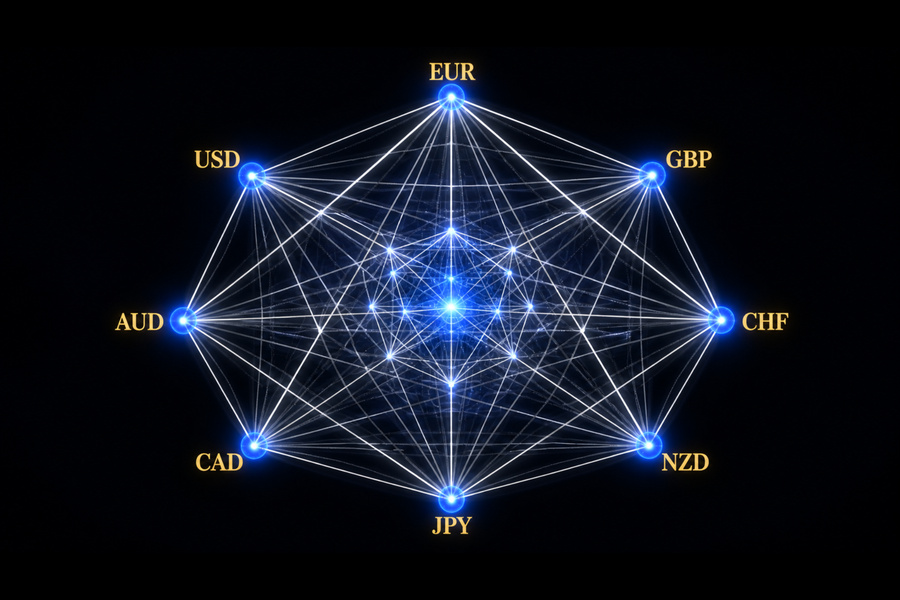
This architecture reflects a false assumption about the market: that the 28 major currency pairs are separate instruments. They are not. They are 28 simultaneous outputs of a single algebraic system involving eight currencies. The system has one state at any given moment, and that state determines all 28 pair values simultaneously. No pair can change independently of the others, because every pair shares currencies with other pairs, and those shared currencies are the common variables that bind the system together.
Reading 28 separate time/price charts in sequence is not the same as reading the system. It is reading 28 projections of the system onto a two-dimensional time/price plane, one pair at a time, and trying to reconstruct the system from those projections mentally. The information lost in those projections, the algebraic relationships between pairs, the geometric structure of currency positions, the constraints that propagate through the system from any single movement, is not recoverable by looking at more charts. It requires a different representation entirely.
A Cartesian model of the full system does not require you to switch between pairs. All eight currencies are present simultaneously as coordinate positions. All 28 pairs are visible as geometric relationships between those positions. A movement in any currency is immediately visible as a displacement that affects every pair involving that currency. The market is present as a single object, not as a collection of separate charts that you must mentally combine.
The practical difference is in what you can see. On separate time/price charts, you can see what EUR/USD is doing. On a complete system view, you can see what EUR is doing across all seven of its major pairs simultaneously, what USD is doing across all seven of its major pairs simultaneously, and how those movements relate to the geometric state of the broader system. You see the cause, not only the effects.
jMathFx is built to give you the system, not the fragments. Start at jMathFx.com.