
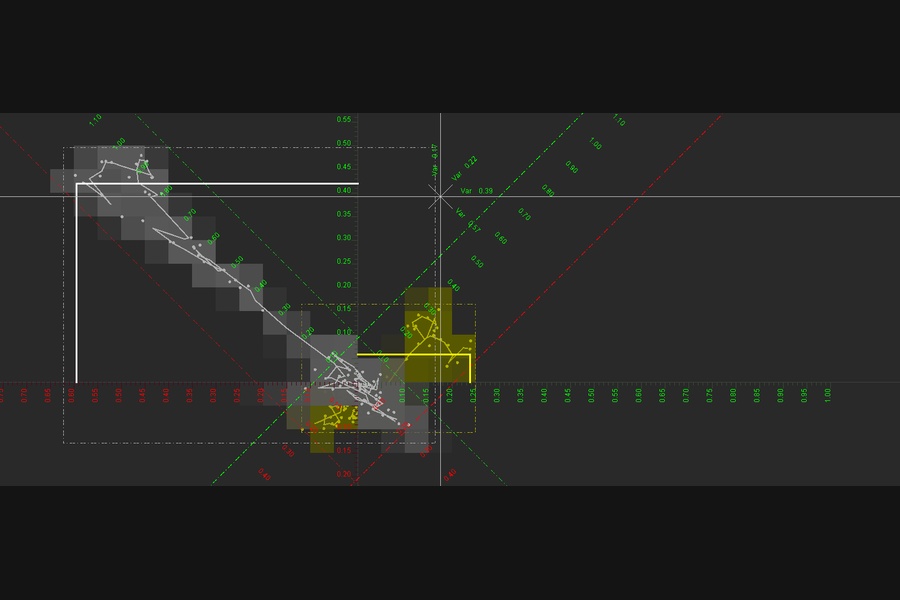
Gurus measure volatility using lagging indicator formulas like Average True Range or Bollinger Bands. These tools tell you what range the price has already covered. They explain zero about the structural causes of volatility. By projecting currency coordinates on the Cartesian plane, I observe volatility as a geometric cycle of contraction and expansion.
During periods of low volatility, the coordinates of the 8 major currencies cluster closely together on the relational plane. The distances between them are narrow, and the cross-rates fluctuate within tight ranges. This phase is coordinate contraction.
Because the system is closed, coordinates cannot remain clustered indefinitely. Economic transactions and interest rate differentials generate force vectors that pull the coordinates apart. The transition from contraction to expansion can be calculated as the rate of change of coordinate dispersion:
Dispersion = Sum((xi - Mean)²) / N
When the dispersion exceeds a critical threshold, the cluster breaks, and the coordinates expand rapidly towards the outer boundaries of the Price Cloud.
Traditional traders attempt to predict volatility breakouts by looking for chart patterns. Coordinate analysis allows you to calculate the expansion phase based on the geometry of the system. By measuring the density of the coordinate cluster, you can identify when the system is in an unstable state.
This spatial analysis allows you to position your trades before the expansion phase occurs. Stop guessing when a breakout will happen. Monitor the geometric cycle of the system to know when expansion is mathematically required.
Related reading: Why Your Pip Cost Changes Every Second