
A forex forecast that covers more than one currency pair must satisfy a condition that almost no forecasting tool addresses: algebraic consistency. Without it, the forecast is not merely uncertain. It is internally contradictory.
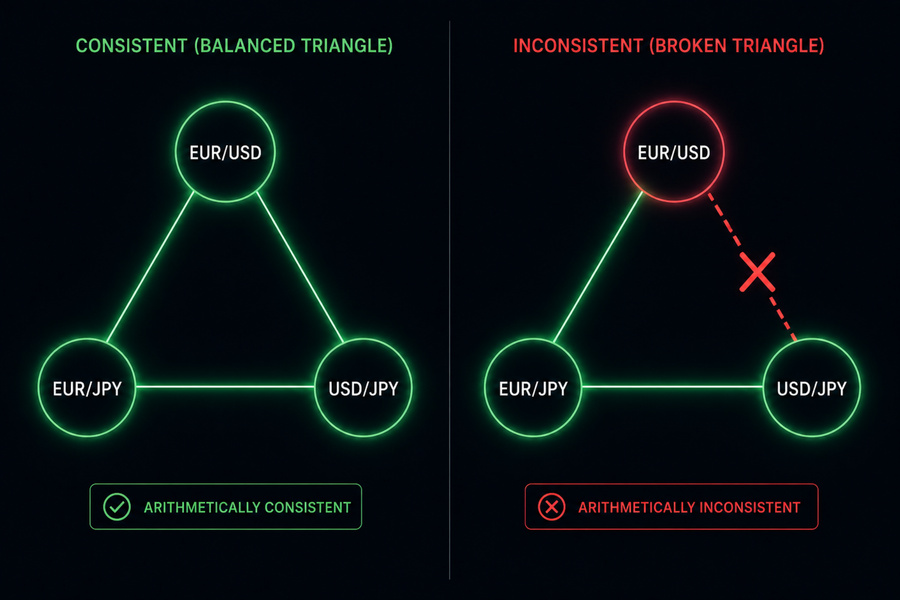
The reason is structural. The 28 major currency pairs are not independent instruments. They are generated by eight currencies whose exchange rates are arithmetically related. If you forecast EUR/USD, EUR/JPY and USD/JPY in a way that violates the relationship EUR/USD = EUR/JPY divided by USD/JPY, your three forecasts cannot all be correct simultaneously. They contradict each other by construction. At most one can be right, and even then only by accident.
This is not a theoretical concern. Every trader who looks at multiple time/price charts and forms independent views on each pair is implicitly making forecasts that have some probability of being algebraically inconsistent. The time/price chart provides no feedback on whether the views are consistent. There is no indicator that turns red when your EUR/USD and EUR/JPY forecasts imply a USD/JPY level that contradicts your USD/JPY forecast. The inconsistency is invisible inside the charting paradigm.
Algebraic consistency is a necessary condition for a forex forecast to be meaningful. Not sufficient, but necessary. A forecast that fails this condition does not need to be evaluated against the market. It is wrong by definition before the market opens. It requires at least one of its components to be incorrect, because the algebraic structure of the market prohibits the combination from occurring.
What does it mean to enforce algebraic consistency in a forecast? It means working within a model that represents all 28 pairs simultaneously and ensures that any proposed set of price levels satisfies the arithmetic relationships between them. It means treating the market as what it is: a closed algebraic system where every element constrains every other element.
Time/price charts cannot enforce this. They were not designed for it. They represent one pair at a time and provide no mechanism for checking consistency across pairs. A Cartesian model of the full system can enforce it, because every position in the model is simultaneously part of multiple algebraic relationships, and any inconsistency manifests immediately as a geometric impossibility.
The jMathFx Platform is built on this principle. Every view formed within the framework is algebraically consistent by construction. Start at jMathFx.com.