
There is a persistent myth in the financial markets: that successful trading is a matter of intuition, discipline, or the ability to read visual patterns on a chart. I spent years inside that myth before I realized something that changed everything. The Forex market does not operate on psychology. It operates on mathematics.
Every fluctuation, every spread rebalancing, every cross-rate correlation is the result of calculation algorithms running behind the scenes. The banks know this. The institutions know this. Retail traders, for the most part, do not. And that asymmetry of knowledge is not accidental.
This guide walks through everything from the essential arithmetic that every trader needs to protect their capital, all the way to the advanced relational geometry models that completely redefine how the market can be observed. Not as a sequence of candlesticks moving through time, but as a spatial structure that already contains the information about where the system can and cannot go.
Before anything else, every trader must master a small set of core equations. These are not optional. Without them, every decision is a guess dressed up as analysis.
A pip, Percentage in Point, is the standard unit of price movement. For most pairs it is the fourth decimal place (0.0001); for Japanese Yen pairs it is the second (0.01). The value of a single pip in your account currency is:
$$\text{Pip Value} = \left( \frac{\text{One Pip}}{\text{Exchange Rate}} \right) \times \text{Position Size}$$
On EUR/USD with a standard lot and a USD account, the math cancels cleanly to $10 per pip. On cross-rates where the quote currency differs from your deposit currency, that value changes with every tick. This is not a minor detail. It directly affects how much you are actually risking on every trade.
The most important calculation for anyone who wants to survive long-term is not an entry signal. It is position sizing. Many traders blow their accounts not because their direction was wrong, but because they risked too much on a single trade.
$$\text{Position Size} = \frac{\text{Account Balance} \times \text{Risk %}}{\text{Stop Loss in Pips} \times \text{Pip Value}}$$
Restricting your risk to 1-2% of your account balance per trade means that even a long losing streak cannot destroy your capital. The math protects you when your judgment fails.
To know whether your trading method has a real edge, you calculate its expected value over a large sample of trades:
$$\text{EV} = (\text{Win Rate} \times \text{Average Win}) - (\text{Loss Rate} \times \text{Average Loss})$$
A positive expected value means the system makes money over time according to the Law of Large Numbers. A negative expected value means no amount of emotional discipline will prevent eventual ruin. The math is honest in a way that human psychology is not.
These formulas are necessary but they are only the beginning. The deeper problem lies in the tool that almost every retail trader uses to make decisions: the candlestick chart.
A standard chart plots price on the vertical axis and time on the horizontal axis. Mathematically, this is a function of a single variable:
$$p = f(t)$$
The structural flaw is this: because time is the independent axis, all historical data accumulates to the left, and to the right of the present moment there is nothing. Empty space. The future, in this representation, is an informational void. Every decision is made at the most uninformed point in the entire system.
There is another problem. Because the underlying model has only one variable, the same patterns appear at every scale. Traders are taught to call this multi-timeframe analysis. What it actually is, is the Matryoshka Effect: like Russian nesting dolls, you open a timeframe and find the same shape inside, contributing nothing new.
To escape this limitation, time must be removed from the equation entirely. A currency exchange rate is not an isolated asset moving through time. It is a simultaneous ratio of reciprocity between two monetary domains. No currency pair exists in isolation. When one currency expands or contracts, multiple relationships adjust simultaneously.
If we remove time from the horizontal axis and replace it with a second price, the model becomes:
$$p_1 = f(p_2)$$
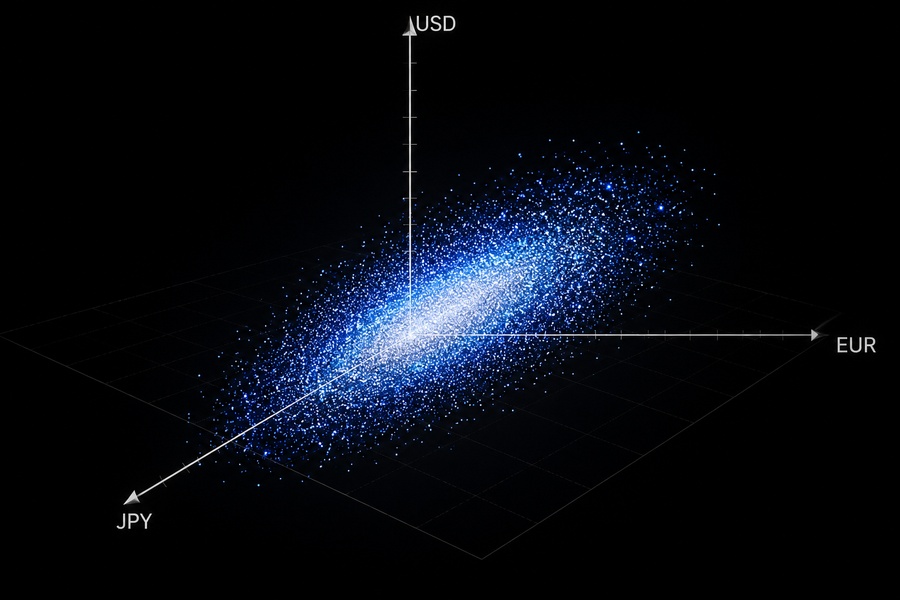
In this relational coordinate system, price is no longer a line growing to the right. It becomes a geometric distribution of points: a Price Cloud. The future is no longer empty space. It is distributed across the plane as a map of constraints, regions where the system can sustain itself and regions where it cannot.
By reading the density of this cloud, you can identify high-density regions of sustainable equilibrium and exclusion zones where the system cannot maintain balance. This is not prediction. It is structural reading.
Calculating these multidimensional coordinate distributions in real-time is not something a human being can do manually. It requires a dedicated calculation engine. That is why the jMathFx Platform exists.
The platform does not add indicators to an already impoverished chart. It reconfigures the entire representation of the market through a double Cartesian system. Plane A maps the USD against a third currency on the X-axis, the EUR against the same third currency on the Y-axis, and represents the EUR/USD cross-rate on the Z-axis. This single view captures the simultaneous fluctuations of 28 exchange rates without visual conflicts. Plane B acts as a control plane, mapping the EUR/USD price against the Pythagorean distance of Plane A coordinates, forcing the trader to verify whether local readings remain coherent when translated into structural relationships.
By shifting from temporal observation to spatial-relational observation, the platform makes errors diagnosable. For a complete overview, see What is jMathFx: A Comprehensive Guide.