
Geometry is not a metaphor for the forex market. It is the actual structure of the forex market. This distinction matters because as long as traders treat geometric language as illustrative rather than precise, they miss the analytical power it carries.
Start with the most basic fact. In a system where each currency is represented as a position on a Cartesian axis, the exchange rate between any two currencies is the ratio of their coordinate values. This is not an approximation. It is exact. The exchange rate between currency A and currency B is the distance relationship between their positions in the coordinate space.
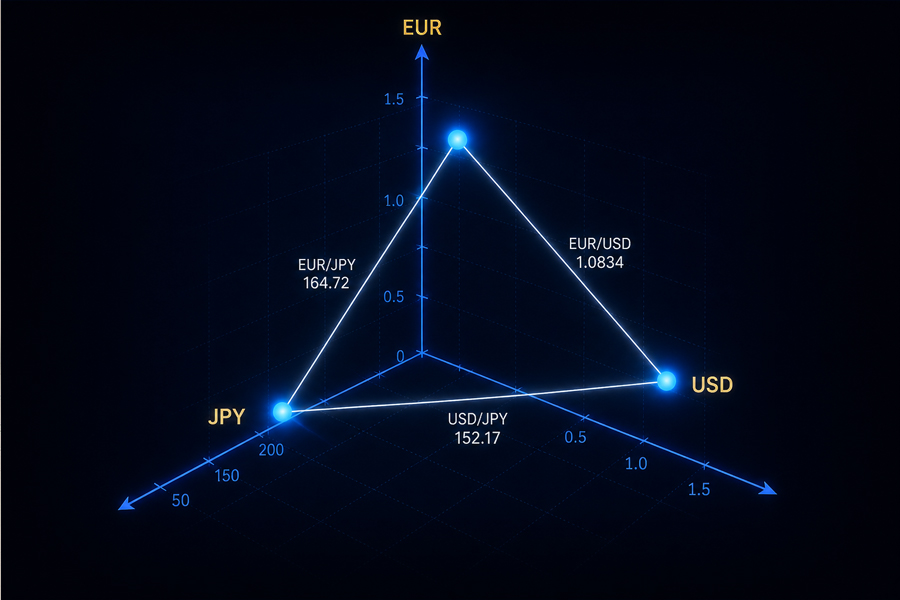
From this, the Pythagorean principle enters directly. If you have three currencies forming a triad, their positions in three-dimensional space define a geometric object. The distances between those positions correspond to the exchange rates between those currencies. The Pythagorean relationship between the sides of that geometric object constrains which combinations of exchange rates are algebraically consistent. It is not a tendency or a pattern. It is a mathematical requirement.
What does this mean in practice? It means that when EUR moves on the coordinate axis, every exchange rate involving EUR adjusts geometrically. The movement is not isolated to one pair. It propagates through the entire structure, and the new positions must remain consistent with the Pythagorean relationships that define the system. A move that violates those relationships is mathematically impossible. The market cannot produce it. Not because of some behavioral tendency, but because arithmetic prevents it.
Traditional time/price charts cannot make any of this visible. A time/price chart plots a single variable against time. It has no axis for the geometric position of a currency in the broader system, no way to represent the Pythagorean constraints between triads, and no mechanism for showing when a proposed price movement would violate the geometric structure. The chart reduces the market to one dimension and discards everything the geometry contains.
A Cartesian model works differently. Instead of plotting price against time, it plots currencies as geometric positions. The distances between positions represent exchange rates. The full geometric structure of the market, including the Pythagorean relationships between every triad, is simultaneously visible. A movement that would break the geometry is immediately identifiable as impossible. A movement that is consistent with the geometry becomes readable as a specific displacement in a known space.
This is the analytical difference between working with a time/price chart and working with a geometric model. One shows you what the price did. The other shows you what the geometry allows. The jMathFx Platform is built on this geometric framework. Explore it at jMathFx.com.