
Academic economists treat Interest Rate Parity as a theoretical model. I treat it as a hard boundary. If you trade without understanding how interest rates constrain currency values, you are trading in the dark. The relationship between spot and forward exchange rates is a mathematical equation that cannot be ignored.
Interest Rate Parity states that the difference in interest rates between two countries must be equal to the difference between the spot exchange rate and the forward exchange rate. If the domestic interest rate is id and the foreign interest rate is if, the forward exchange rate F must satisfy:
F = S * ((1 + id) / (1 + if))
If this relationship is violated, it creates a risk-free profit opportunity called covered interest arbitrage. Capital flows would immediately force the spot and forward rates back into parity. This equation implies that exchange rates are constrained by interest rate differentials.
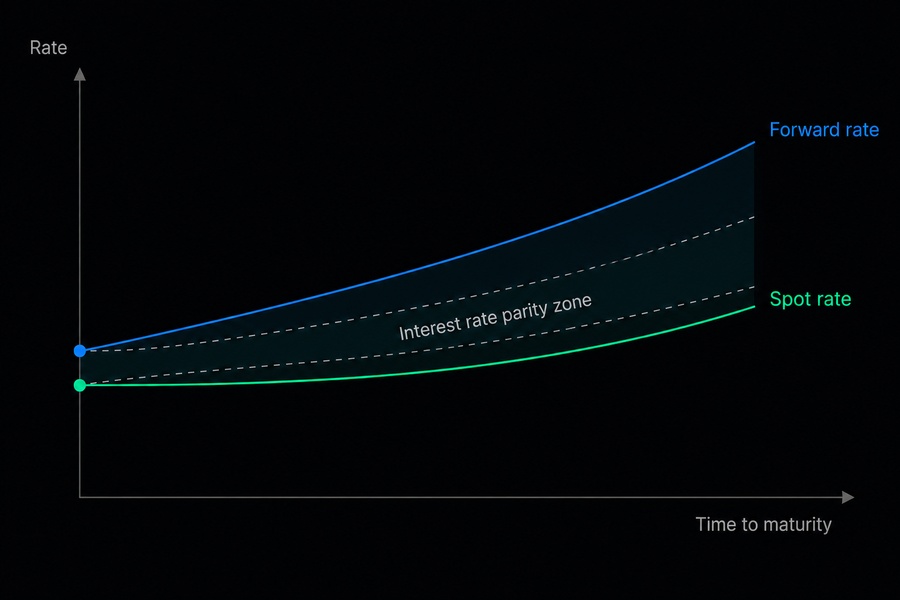
By projecting these interest rate constraints onto the Cartesian plane, you can visualize the forward curve as a spatial trajectory. The coordinates of the spot rate and the forward rate must remain within the boundaries defined by the interest rate differentials.
This spatial model allows you to identify when the market is priced out of parity. By measuring the distance to these boundaries, you can calculate the expected adjustments in the spot rate. Stop guessing which way the currency will move. Calculate the necessary path it must take to satisfy macroeconomic constraints.
Related reading: Purchasing Power Parity in the Foreign Exchange Market: A Comprehensive Analysis with jMathFx Insights