
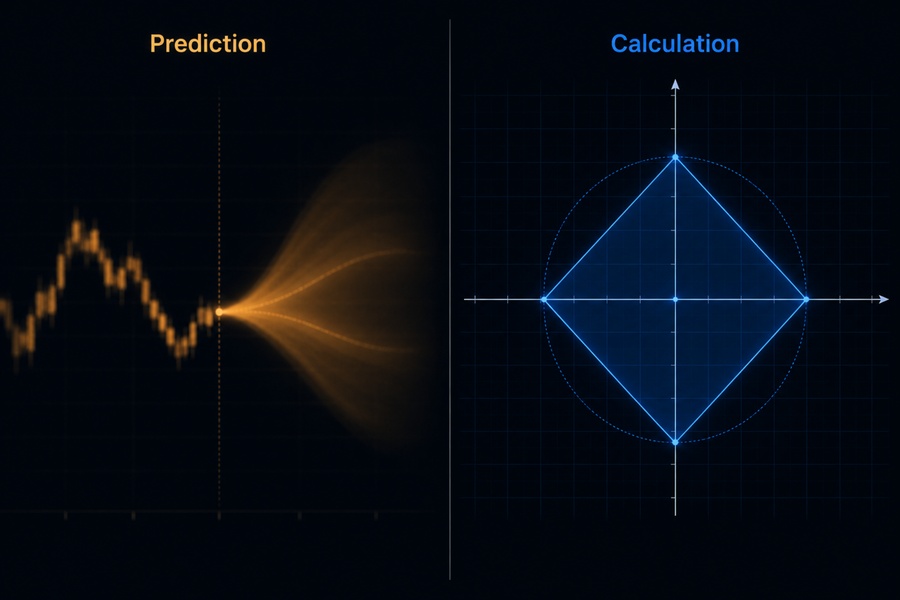
Every forecasting tool in retail trading is built on prediction. Indicators, patterns, sentiment analysis, economic calendars: they all produce a probability estimate. The price is more likely to go up than down. The pattern has historically resolved in this direction seventy percent of the time. The indicator is in overbought territory, which tends to precede reversals. These are probabilistic statements.
Calculation is a different activity. To calculate is to derive a result from a defined set of constraints. The result is not a probability. It is a value that the system must produce, given the constraints that govern it. Two plus two does not probably equal four. It equals four because of the algebraic rules that define addition.
The forex market contains both probabilistic elements and algebraic elements. Which currency appreciates against another over the next hour is probabilistic. But whether a given combination of exchange rates is consistent with the algebraic structure of the market is not probabilistic at all. Either the three rates in a currency triad satisfy the required mathematical relationship or they do not. This is a calculable fact, not a probabilistic estimate.
The distinction has immediate analytical consequences. A trader operating from prediction works with a distribution of possible outcomes and a confidence level for each. Every tool they use is designed to shift that distribution in their favor. A trader operating from calculation works with a space of algebraically possible states. The market can only occupy states that satisfy the algebraic constraints. States that violate those constraints are not improbable. They are impossible.
Time/price charts are tools for prediction. They display historical price sequences that can be used to estimate future probabilities. They have no mechanism for representing the algebraic constraints that define the space of possible market states, because those constraints exist across all 28 pairs simultaneously and cannot be expressed in a two-dimensional chart of a single pair.
A Cartesian model of the full 28-pair system makes those constraints visible. When you know the algebraic structure of the market, you can calculate which price movements are consistent with that structure before they occur. Not predict. Calculate. The jMathFx Platform is the tool built for that calculation. Explore it at jMathFx.com.