
Every charting platform in existence shows you the same thing: a currency pair, plotted against time. The horizontal axis is always time; the vertical axis is always price. This is so universal that most traders never question it.
But there is a fundamental problem with this representation. A single currency pair does not exist in isolation. EUR/USD is not a standalone asset class flowing through time. It is the instantaneous ratio of reciprocity between the Euro and the Dollar, two monetary domains that are simultaneously connected to every other currency in the market. When one shifts, everything adjusts. Analyzing EUR/USD in isolation is like studying one thread of a fabric and concluding you understand the cloth.
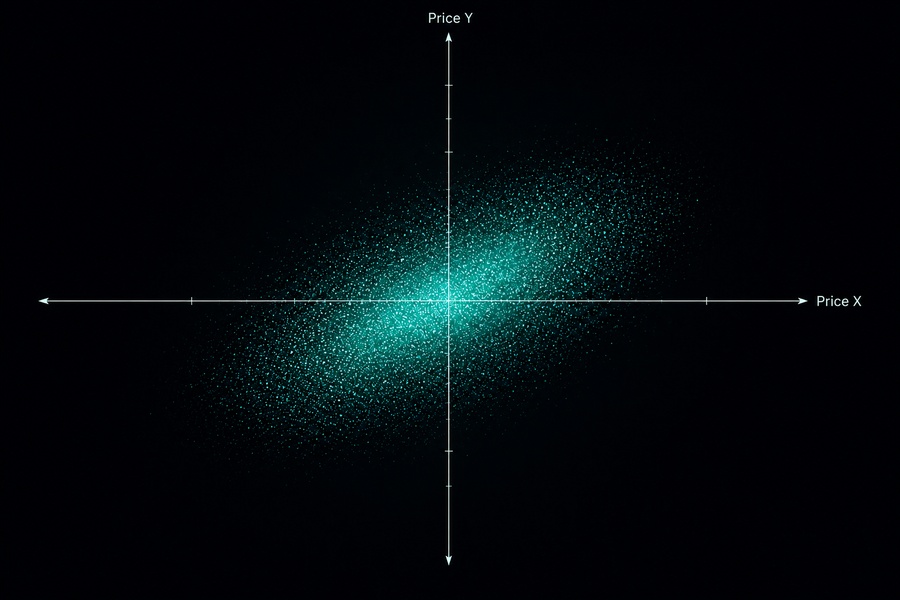
When you plot price against time, you get a sequence: an ordered line moving left to right, accumulating history behind it and leaving only empty space ahead. When you remove time and plot one price against another, the temporal sequence disappears. What remains is a spatial distribution of states, a Price Cloud. Every point in this cloud represents a moment when two currencies occupied those coordinates simultaneously.
The cloud does not grow to the right into emptiness. It populates a plane that already contains the geometry of what the system can and cannot sustain. By reading the density of the Price Cloud, two types of regions become distinguishable. High-density zones are areas of coherent equilibrium, configurations where the system's internal variables can coexist without excessive tension. Exclusion zones are structural voids where the market cannot maintain itself and must redistribute. Trading stops being a forecasting exercise and becomes a reading of systemic constraints.
The jMathFx Platform implements this relational geometry through a dual-plane Cartesian layout. The first, Plane A, maps three currency relationships simultaneously in a single coordinate point. The X-axis carries the value of the US Dollar relative to a third currency. The Y-axis carries the value of the Euro relative to the same third currency. The Z-axis carries the EUR/USD exchange rate.
Instead of analyzing one pair in isolation, every point on Plane A encodes three relationships at once. When historical data is loaded, Plane A displays the existence domain of these currencies as a spatial point cloud. The structural boundaries become visible without any visual conflict between competing lines and indicators. This is not a different way to look at the same information. It is access to a dimension of information that the standard chart does not contain.
The second plane, Plane B, serves as a mathematical validator. Its horizontal axis carries the EUR/USD exchange rate. Its vertical axis carries the internal distances of Plane A calculated using Pythagorean logic:
$$d = \sqrt{(x_2 - x_1)^2 + (y_2 - y_1)^2}$$
This distance measures the structural tension between currency relationships, how far the system is from its nearest zone of coherent equilibrium. If a position looks locally stable on Plane A but shows an extreme distance deviation on Plane B, it reveals a tension that must eventually resolve. The trader is no longer relying on a visual impression. They are reading a structural measurement.
The most important conceptual shift this approach enables is the replacement of prediction with selection. Traditional trading asks: where is the price going? The relational approach asks: where can the system currently sustain itself? These are not the same question. The first requires forecasting an unknowable future. The second requires reading an already-present structure.
For a deeper look at how this framework supports capital allocation, see The Math of Risk Management in Forex. For the platform overview, visit What is jMathFx: A Comprehensive Guide.