
A losing position in forex is typically managed in one of two ways: absorb the loss by closing, or hold and hope for reversal. Both approaches treat the position in isolation, as if the pair you are trading exists independently of the other 27. In a closed algebraic system, that isolation is an analytical error.
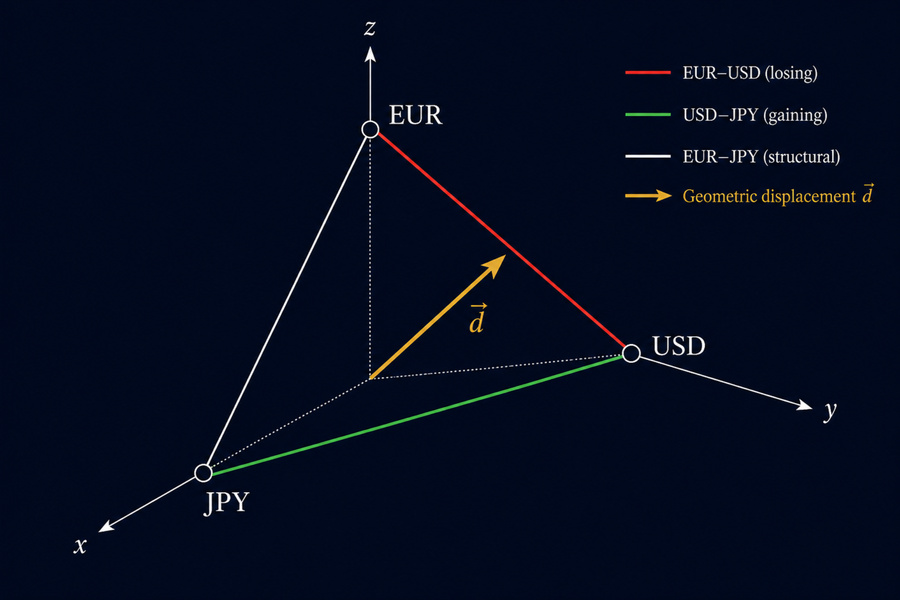
Every currency participates in multiple pairs. When a position in EUR/USD is losing, that loss reflects a specific geometric displacement of the EUR or USD coordinate, or both. That displacement does not affect only EUR/USD. It propagates across every pair involving EUR and every pair involving USD. The algebraic system has moved as a whole. The question is not only where EUR/USD will go next, but what the full geometric state of the system implies for the position.
Cross-currency algebraic relationships define exact offset conditions. If EUR/USD is losing because USD has gained coordinate position in the system, then pairs that are long on USD are gaining. The gain in those pairs is not accidental. It follows from the same geometric displacement that is costing the EUR/USD position. The relationship between the loss and the gain is algebraically determined, not estimated.
This means that recovery from a losing position can, under specific structural conditions, be approached through a cross-currency operation rather than through time. Instead of waiting for EUR/USD to reverse, you identify the pair that is gaining as a consequence of the same structural movement that is creating the loss, and you take a position in that pair. The recovery is not a gamble on reversal. It is an algebraically defined operation on the same geometric displacement that caused the loss.
Time/price charts make this invisible. Each chart shows only one pair. There is no mechanism for seeing the geometric displacement that is simultaneously affecting multiple pairs, no way to identify the exact cross-currency relationship between a losing position and a gaining one, and no analytical framework for constructing an offset operation from the structure of the system.
Working within a Cartesian model of the full system makes the structural connections explicit. The displacement that is costing one position is visible as a geometric shift. The pairs that are gaining from the same shift are identifiable. The algebraic relationship between them is calculable. The jMathFx Platform is built to expose these connections. Explore it at jMathFx.com.