
Stop loss is a tool designed for a specific condition: not knowing where the market is going. If you cannot identify the boundaries of the possible price space for the pair you are trading, you need a mechanism that removes you from the trade before an adverse move becomes catastrophic. Stop loss is that mechanism. It is a rational response to genuine uncertainty.
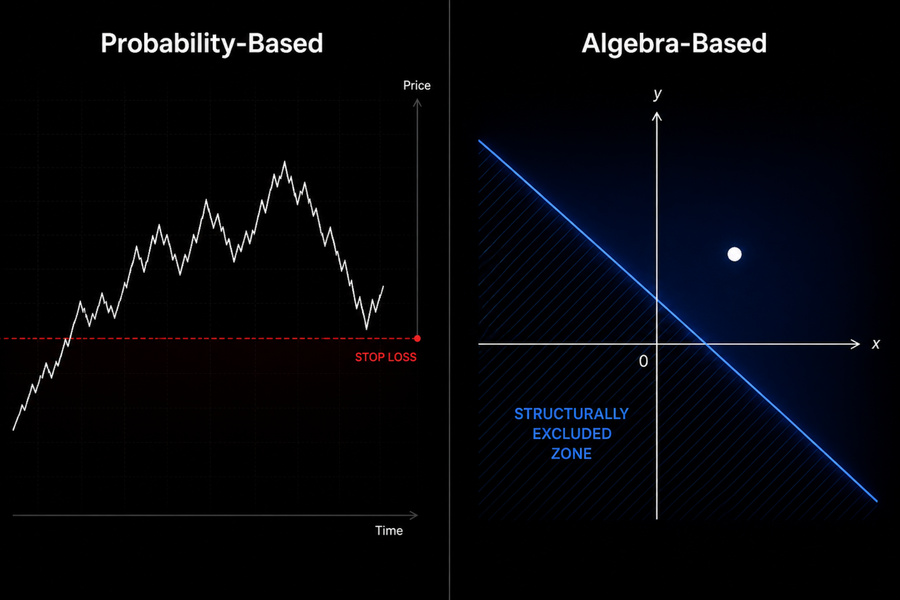
The question worth asking is whether that uncertainty is irreducible, or whether it is a product of the analytical framework being used. If the framework shows you one pair on a time/price chart in isolation, the uncertainty is very high. The chart cannot tell you where price cannot go. It can only show you where price has been. Stop loss is the only available response to that uncertainty.
A mathematical framework changes the structure of the problem. The forex market is a closed algebraic system. The exchange rates that the market can produce from its current state are constrained by the algebraic relationships between all 28 pairs. A price level that is algebraically impossible from the current system state is not a risk. It is excluded from the space of outcomes before the market moves.
This does not mean risk disappears. The algebraic framework does not tell you which of the possible prices the market will choose. What it does is reduce the size of the uncertainty space. Levels that are algebraically excluded are removed from consideration entirely. The remaining uncertainty concerns which algebraically consistent state the system will move to, not whether it will somehow violate arithmetic.
The practical implication is that position management within an algebraic framework can be based on structural reasoning rather than on arbitrary price levels below the entry. Instead of placing a stop loss at a distance from the entry that the trade can survive statistically, you place your positions in relation to the geometric structure of the system, and you manage them in response to changes in that structure. If the structure supports the position, you hold it. If the structure shifts against it, you respond to the shift, not to a pre-set price level.
Stop loss is not obsolete because risk disappears inside a mathematical framework. It becomes less necessary because the algebraic structure of the market makes the space of actual risk visible. The jMathFx Platform is built to keep that space in front of you. Start at jMathFx.com.