
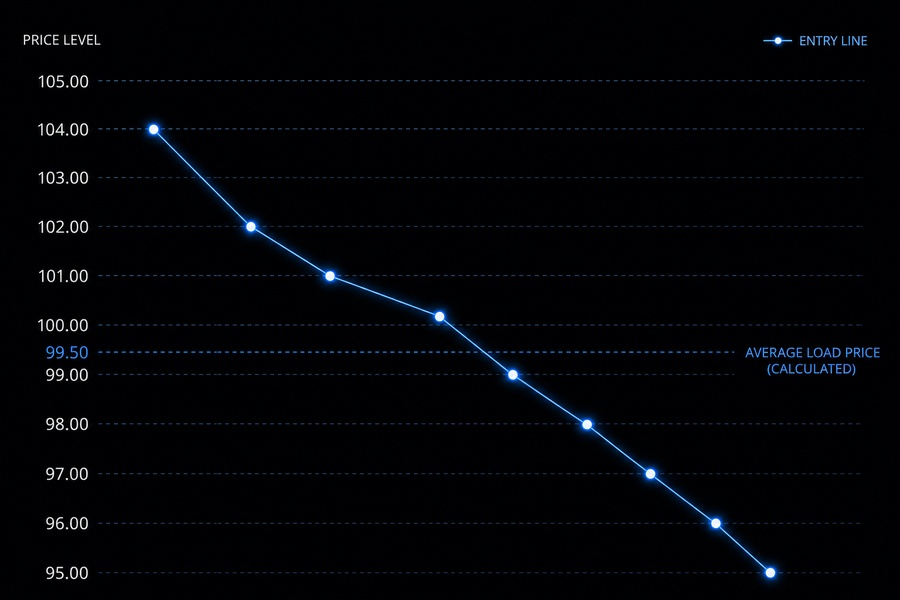
Grid trading sounds easy. You place orders at set intervals, wait for price to swing, and collect. But if you run a grid without calculating your net exposure, you are begging for a margin call. In a grid, your exposure grows as an arithmetic progression, not a linear one. I rebalance grid exposure using coordinates on the Cartesian plane to avoid getting wiped out.
In a standard grid, each level adds to your total position size. The exposure does not increase linearly. It increases as an arithmetic progression. If you open a series of positions of size L, your total exposure after n levels is:
E_total = Sum(L_i) = n * L
The margin required to support these positions increases, while the distance to your margin call decreases. Because the market coordinates move in a closed system, a grid on a single pair is exposed to the absolute volatility of that pair. If the exchange rate experiences a sustained displacement, the grid enters a state of negative feedback where the loss increases exponentially.
To manage a multi-position system safely, you must rebalance your exposure using related currency coordinates. Instead of allowing a single-pair grid to accumulate drawdown, you offset the risk by opening compensatory positions in related cross-rates.
This spatial rebalancing is calculated using the algebraic constraints of the currency triad. By distributing exposure across coordinates on the Cartesian plane, you neutralize the net directional risk of the grid. You are no longer hoping the market returns to your entry price. You are utilizing the geometric structure of the system to manage your total drawdown. Calculate your boundaries or the market will close you out.
Related reading: The Constraint That Links All 28 Fx Pairs