
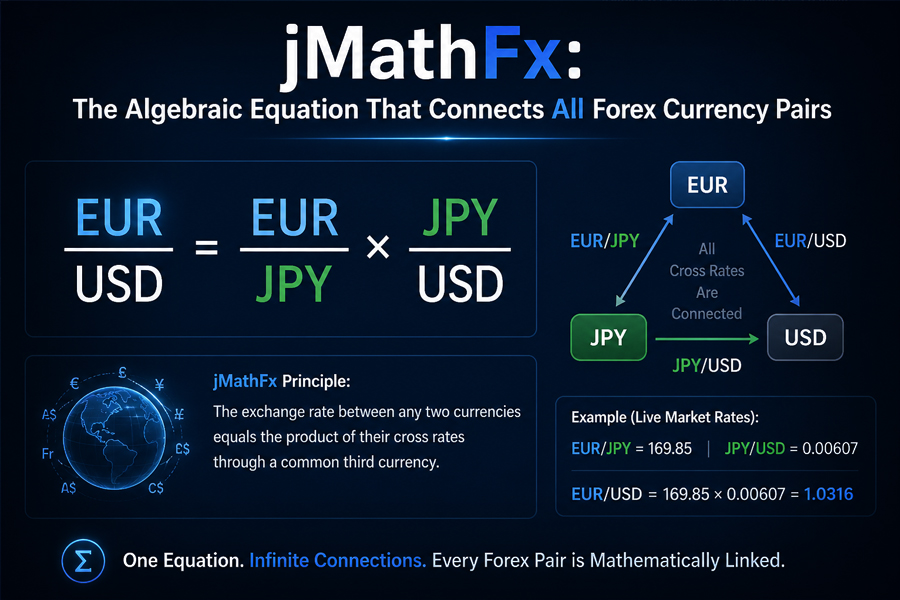
There is one equation that governs every exchange rate on the planet. It has been true since the first currency pair was quoted. It will be true tomorrow. It cannot be arbitraged away, overridden by central banks, or suspended during periods of high volatility.
It looks like this:
EUR/USD = EUR/JPY ÷ USD/JPY
This is not a trading strategy. It is not an indicator. It is arithmetic. The same arithmetic that says if A equals B divided by C, then B and C cannot move without affecting A. Always. In every market condition. At every moment.
The implications are enormous and almost entirely ignored by the trading industry.
If EUR/JPY rises while USD/JPY stays flat, EUR/USD must rise. Not probably. Not historically. Mathematically. The equation does not allow another outcome. And this interdependence holds across all 28 major currency pairs simultaneously, because every pair shares at least one currency with at least two others. The forex market is not 28 independent instruments. It is one algebraic system with 28 expressions.
Traditional analysis treats each pair as a separate entity. A trader watches EUR/USD on one chart, maybe opens a second chart for GBP/USD, they seem correlated, and calls that a strategy.. But observing a relationship is not the same as understanding the algebraic constraint that produces it. Algebra is a constraint. It does not bend under pressure. It does not disappear in volatile conditions. It holds because the math holds.
The practical consequence is this: when you analyze a single currency pair in isolation, you are not analyzing the forex market. You are analyzing a variable while ignoring the equation it belongs to. You would not try to solve for X while ignoring the rest of the formula. But that is exactly what single-pair analysis asks you to do.
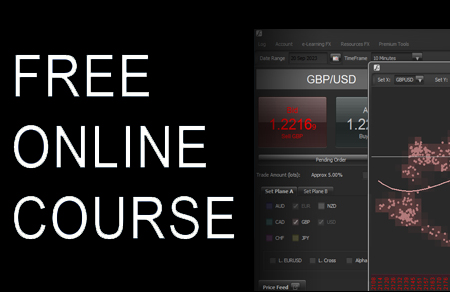
jMathFx was built to make this equation visible at scale. Not just EUR/USD, EUR/JPY and USD/JPY. All 28 pairs. All interrelations. All constraints. Simultaneously. The platform maps the entire system onto a three-dimensional Cartesian model where every position of every currency is geometrically consistent with every other position. When the system shifts, you see it shift as a whole. Not as 28 separate events.
That is the difference between watching fragments and reading a system. Explore the jMathFx Platform at jMathFx.com and see what the equation looks like when it is finally made visible.