
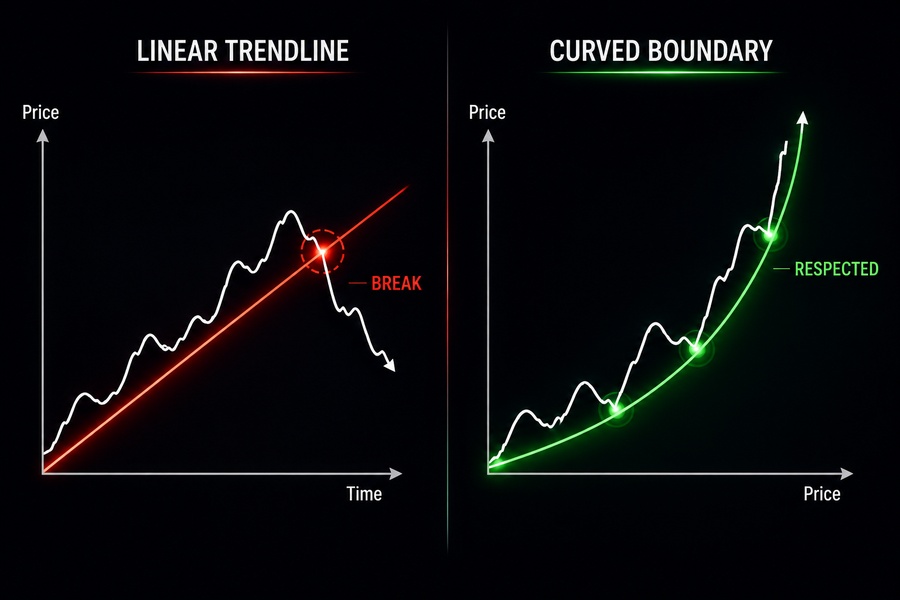
Drawing trendlines on a time/price chart is complete garbage. You draw a line connecting a few random lows, extend it into the future, and call it support. When the market smashes right through it, you make up an excuse. The truth is that trendlines are mathematically invalid because they assume price is a function of time:
p = f(t)
Price is not a function of time. Price is determined by coordinate shifts in space. When the coordinates of a currency move, they violate visual paths because the structural boundaries of the system have shifted.
A trendline is a linear regression constructed across a time series. Because time is a non-value variable, this line is a description of history, not a calculation of value. The angle of the trendline depends entirely on the scale of your chart. If you change the aspect ratio, the angle changes. If you change the timeframe, the line disappears or shifts. This scale-dependence is proof that the line has no objective reality. It is a visual artifact, not a physical barrier.
In coordinate space, price movement is represented as the displacement of a point on a plane. The boundaries that constrain this displacement are defined by the algebraic limits of the currency triad. These boundaries are invariant; they do not change when you alter your chart scale or your timeframe. They are the true structural limits of price movement.
Instead of drawing lines on charts, I calculate the boundaries of the system using Cartesian coordinates. Support and resistance are not historical price levels; they are regions of coordinate exclusion defined by the algebraic limits of the market.
When price approaches one of these boundaries, it experiences structural resistance. By measuring the distance to these zones, you can calculate where the price movement must stop. This coordinate analysis replaces visual storytelling with mathematical calculation. Stop drawing. Start calculating.
Related reading: Why Time Is the Wrong Variable in Forex