
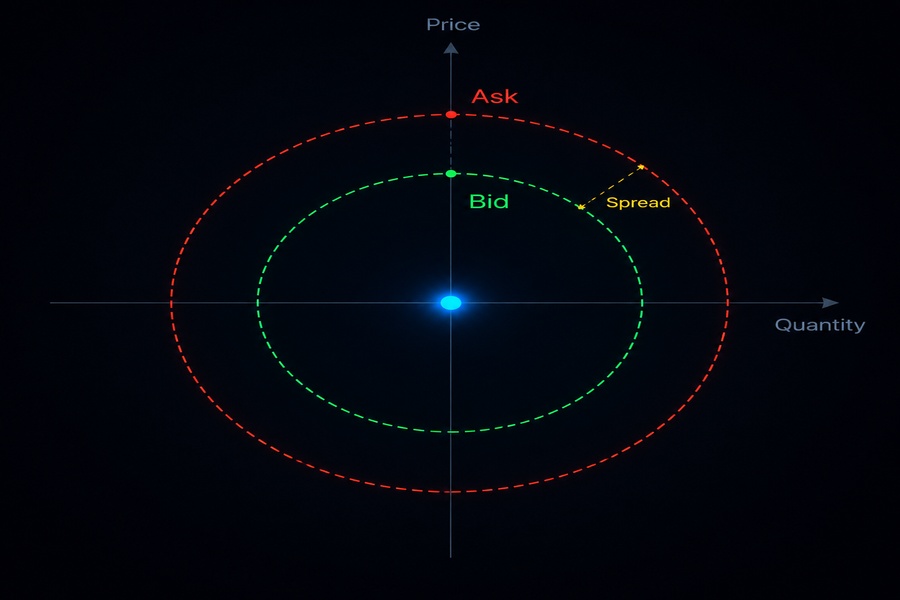
Every transaction in the foreign exchange market requires paying the spread. The spread is the difference between the bid price (what you can sell at) and the ask price (what you can buy at). While retail traders treat this cost as a static fee, it is actually a dynamic parameter determined by interbank liquidity. I display spreads in coordinate space to show you the real cost of trading.
The spread represents the premium charged by liquidity providers to match orders. In a Cartesian coordinate system, the bid and ask price levels are represented as boundaries around the currency coordinates. The width of this boundary is determined by the volume of available orders:
Spread = Pask - Pbid
When liquidity is high, many orders are nested closely together, resulting in a narrow spread. When liquidity drops, the distance between the available order coordinates increases, forcing the spread to widen. Because the 28 currency pairs are algebraically linked, the spreads of the cross-rates are constrained by the spreads of the major pairs.
To minimize transaction costs, you must analyze the spatial density of the Price Cloud. By identifying when the coordinates are in high-density regions, you can execute trades when spreads are narrowest.
This spatial analysis allows you to avoid trading during periods of liquidity contraction. You are no longer accepting whatever spread your broker quotes. You are calculating the optimal coordinates for execution. Stop paying excessive transaction fees by avoiding low density spaces.
Related reading: Why Your Pip Cost Changes Every Second