
Traditional hedging is lazy, expensive broker food. You open a trade, it goes against you, and you open an opposite trade on the same pair. You pay double spreads to sit in a flat freeze. This basic approach completely ignores the multi-currency structure of the market. When you understand the closed algebraic system of exchange rates, you can construct synthetic hedges using multiple pairs. This multidimensional risk management provides true protection.
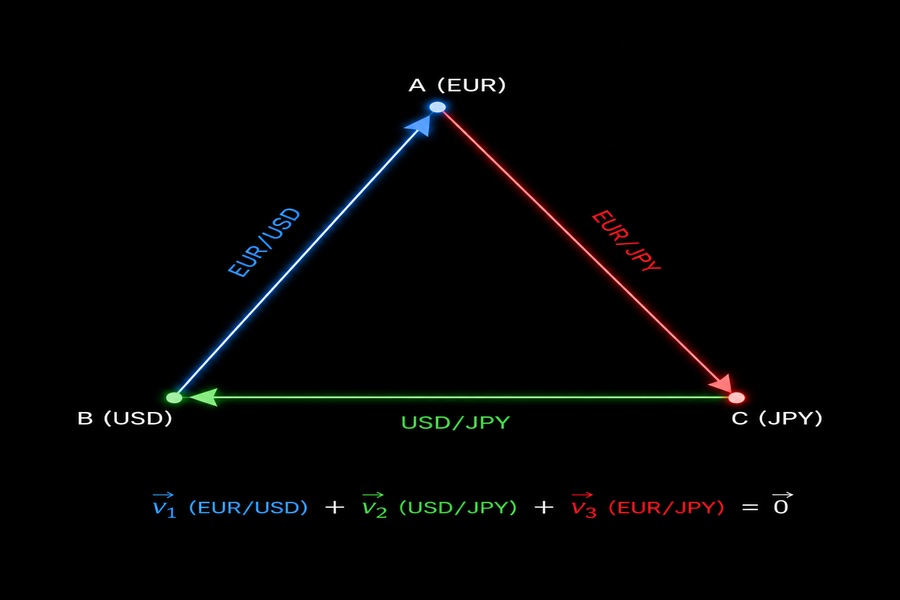
A synthetic hedge is constructed by balancing exposures across related currency coordinates. If you hold a long position in EUR/USD, your risk is tied to the relative movement of the Euro and the Dollar. Instead of hedging with a short position in EUR/USD, you can distribute the exposure across EUR/JPY and USD/JPY.
The net exposure is determined by the algebraic combination of the position sizes. If the position sizes satisfy the cross-rate equations, the net exposure to the Dollar can be neutralized while maintaining a specific exposure to the Euro and the Yen. This relationship is governed by the vector sum of the coordinates:
Net Exposure = E(EUR/USD) + E(USD/JPY) + E(JPY/EUR) = 0
By structuring positions in a closed loop, you neutralize systemic exposure while exploiting spatial deviations.
Traditional hedging is binary: you are either exposed or you are flat. Synthetic hedging on the Cartesian plane allows you to manage risk as a spatial configuration. You can adjust the dimensions of your hedge as the coordinates move through the Price Cloud.
I don't use the standard stop loss that brokers use to hunt your money. I look at the density of the price coordinates. When they cluster in high-density zones, my exposure is safe. When they approach the empty exclusion zones, I neutralize the risk. It is pure algebra, not hope.
Related reading: The Math of Risk Management in Forex