
You expect your orders to execute at the exact price you click on. This is a naive retail expectation. In the live interbank market, there is always a lag between your order transmission and its execution. This lag, combined with liquidity gaps, creates slippage. I model this execution risk using basic physics.
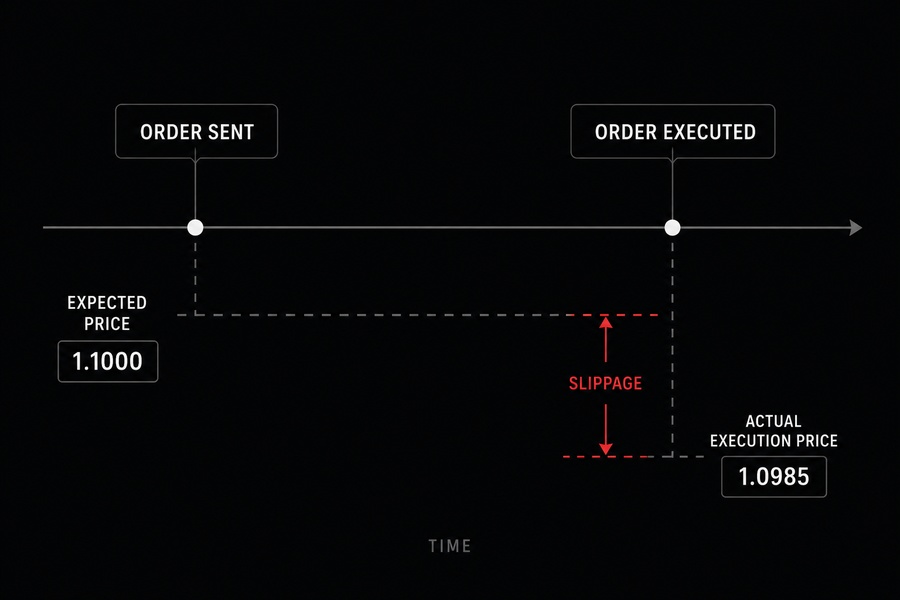
Slippage is the difference between the requested price and the price at which the order is filled. This friction is not a broker manipulation. It is a mathematical consequence of order matching. When you click buy, your request is sent to a liquidity provider. During the transmission time, the coordinates of the currency move.
The deviation can be calculated as the product of price velocity and latency:
Δp = (dp / dt) * Δt
If the price velocity is high or the latency is long, the executed price will deviate significantly from your request. This execution friction is particularly high during economic news events when liquidity drops and price velocity increases.
To protect your capital, you must incorporate slippage into your risk models. A strategy that relies on very small target profits will be rendered unprofitable by a few pips of slippage.
By visualizing the market as coordinate points in the Price Cloud, I identify regions of high volatility where slippage is likely to occur. This spatial analysis allows you to avoid executing orders in high-risk zones, ensuring your transactions remain within the safety parameters of your system. Stop placing orders blindly during high velocity periods.
Related reading: Why Time Is the Wrong Variable in Forex