
A time/price chart has two axes. Time runs horizontally. Price runs vertically. Every piece of information the chart contains is a function of these two dimensions. This is the representation that the entire retail trading industry is built on. It is also, geometrically, insufficient for the forex market.
The forex market is not a two-dimensional system. It is a network of eight major currencies generating 28 pairs, where every rate is the ratio of two currency values and every currency value is simultaneously present in multiple pairs. To represent this system accurately you need at minimum three dimensions: one for each currency value in a triad. A 2D chart collapses a multi-dimensional algebraic system into a single line. Information is not simplified. It is destroyed.
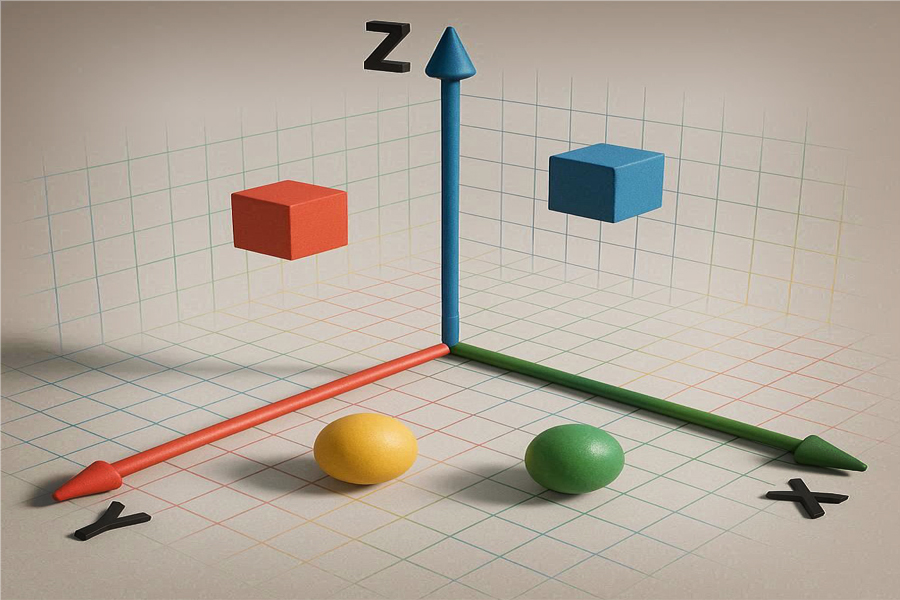
A three-dimensional Cartesian model works differently. Instead of plotting price against time, it plots currencies as geometric positions in space. Each axis represents a currency. The distance between two points on the model corresponds to an exchange rate. The position of every currency relative to every other currency is simultaneously visible. When one currency moves, its geometric displacement across the entire model is immediate and measurable. Nothing is hidden. Nothing is collapsed into a single line.
The practical difference is significant. On a time/price chart, a movement in EUR/USD appears as a bar changing height. You see the outcome. You do not see which currency moved, by how much, or what the movement implies for the 13 other pairs involving EUR or USD. On a three-dimensional Cartesian model, the same event appears as a geometric displacement. You see EUR moving relative to USD, and simultaneously relative to every other currency in the system. The cause is visible. The consequences across the full 28-pair structure are visible. The model does not show you what happened. It shows you what the system did.
This is not a visual preference. It is a mathematical requirement. The algebraic properties of the forex market can only be fully represented in a space that has enough dimensions to contain them. Two dimensions are not enough. Three dimensions, organized as a Cartesian model with currencies as geometric positions, is the minimum representation that preserves the full algebraic structure of the market.
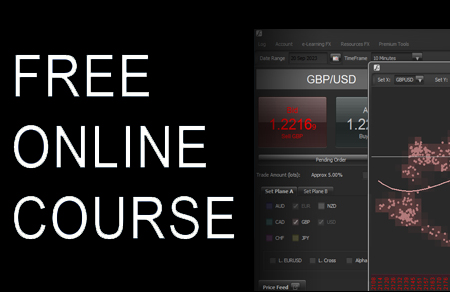
jMathFx was built on this principle. The platform maps all 28 major currency pairs onto two Cartesian planes, Piano A and Piano B, making the geometric position of every currency visible simultaneously on a single screen. What a time/price chart hides inside a sequence of bars, the jMathFx model exposes as geometry. Explore the platform at jMathFx.com.