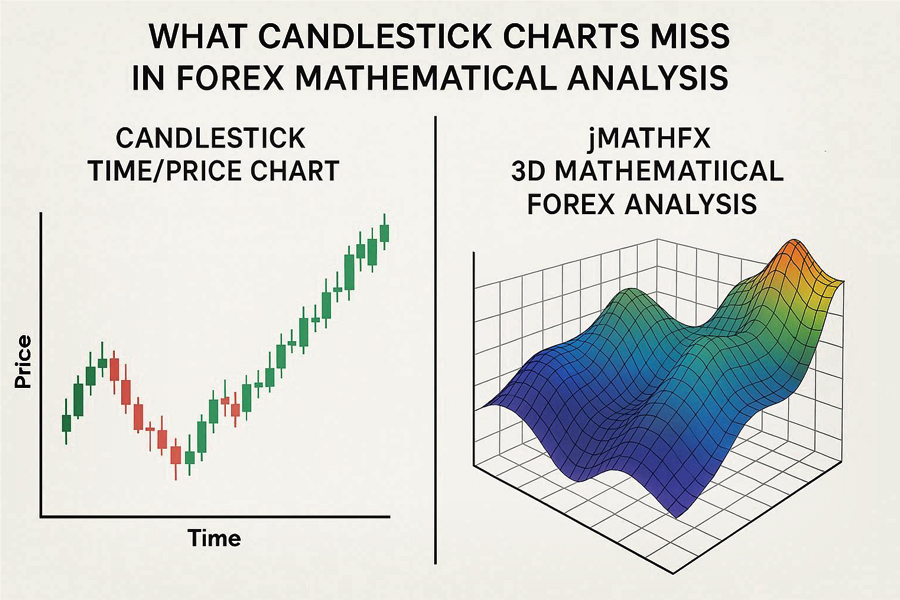
The candlestick was invented in eighteenth-century Japan to track rice prices. It records four data points: the opening price, the closing price, the high and the low within a given time interval. For over two centuries, this has been the dominant tool for reading financial markets. It is also, structurally, a time/price chart. Nothing more.
This is not a criticism of the candlestick. It is a description of what it is and, more importantly, what it is not.
A time/price chart answers one question: where did this pair trade during this interval? It does not answer where the pair stands relative to the other 27 pairs that share its currencies. It does not show whether the current price is algebraically consistent with the rest of the market. It does not reveal whether a movement was driven by a shift in the base currency, the quote currency, or both. It records an outcome. It does not expose the mathematical structure that produced it.
Traders have spent decades trying to extract predictive information from candlestick patterns. Doji, engulfing, hammer, shooting star. Each pattern is a visual description of price behavior within a time interval. None of them are derived from the algebraic properties of the forex market. They are observations, not proofs. They work until they do not, and no mathematical principle explains when that will happen.
The deeper problem is this. The forex market is not a time/price system. It is an algebraic system with a time/price surface. What traders see on a candlestick chart is the surface. The algebraic structure underneath, the one that actually determines where prices must go next, is invisible to any tool that only records time and price.
To read that structure you need a different kind of representation. Not a better time/price chart. A fundamentally different model. One that maps currencies as geometric positions in space, tracks their movement relative to each other across all 28 pairs simultaneously, and makes the algebraic constraints of the market visible rather than hiding them behind a sequence of colored bars.
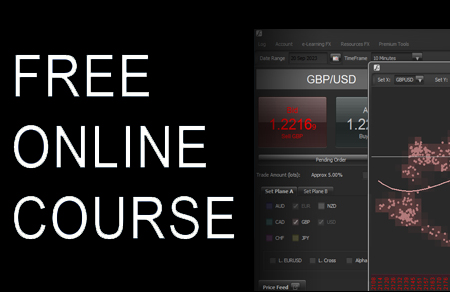
jMathFx does not replace the candlestick with a better version of the same thing. It replaces the time/price paradigm entirely. The platform maps all 28 major currency pairs onto a three-dimensional Cartesian model where price is not a bar on a timeline but a geometric position within a closed algebraic system. The constraints become visible. The movements become calculable. The market stops being a sequence of patterns and becomes a structure with rules.
The candlestick tells you what happened. jMathFx tells you what the math requires to happen next. Explore the platform at jMathFx.com.