
Every indicator in the standard forex toolkit is an attempt to measure something about price behavior. Momentum, trend strength, overbought and oversold conditions, volatility. These are useful concepts in a statistical framework. They are also fundamentally uncertain, because they derive from historical price sequences and project that history into the future probabilistically.
Price confidence is a different kind of quantity. It is not derived from history. It is derived from the current algebraic state of the market. Specifically, price confidence measures how consistent a proposed price level is with the geometric constraints imposed by the full 28-pair system at this moment.
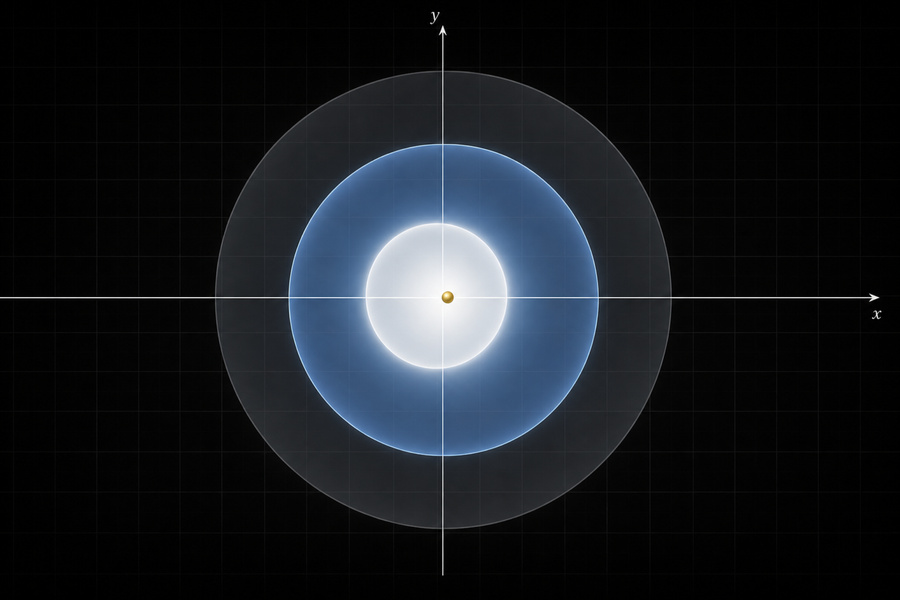
The concept emerges directly from the structure of the market. When all eight major currencies are positioned on a Cartesian model, the coordinate of each currency is constrained by its exchange rates against the other seven. A currency that has strong, consistent geometric support from multiple other currencies in the system is in a structurally confident position. A price level for a pair involving that currency, that is consistent with the full geometric structure of the system, has algebraic support. It is not merely likely. It is structurally consistent.
A price level that would require other currencies to violate the geometric relationships they currently maintain has no algebraic support. It might occur if those other relationships change first. But in the current state of the system, the proposed level is geometrically unsupported. This is what low price confidence means in the algebraic framework: not that the market is unlikely to reach a level, but that reaching it would require a structural change elsewhere in the system first.
The reason price confidence replaces indicators is that it measures the same thing indicators are attempting to measure, but from the structure of the market rather than from the history of the price. Indicators ask: what has price done, and what does that imply about what it will do? Price confidence asks: what does the current structure of the system allow? The second question has a more precise answer.
Traditional indicators cannot compute price confidence because they operate on single-pair time/price charts. The geometric structure that defines price confidence is a property of the full 28-pair system and requires a Cartesian model to represent it. The jMathFx Platform makes price confidence visible in real time. Explore the framework at jMathFx.com.