
Describing a mathematical approach to forex trading in abstract terms is easy. Describing what it actually looks like, step by step, from market observation to position decision, is less common. Here is a concrete account.
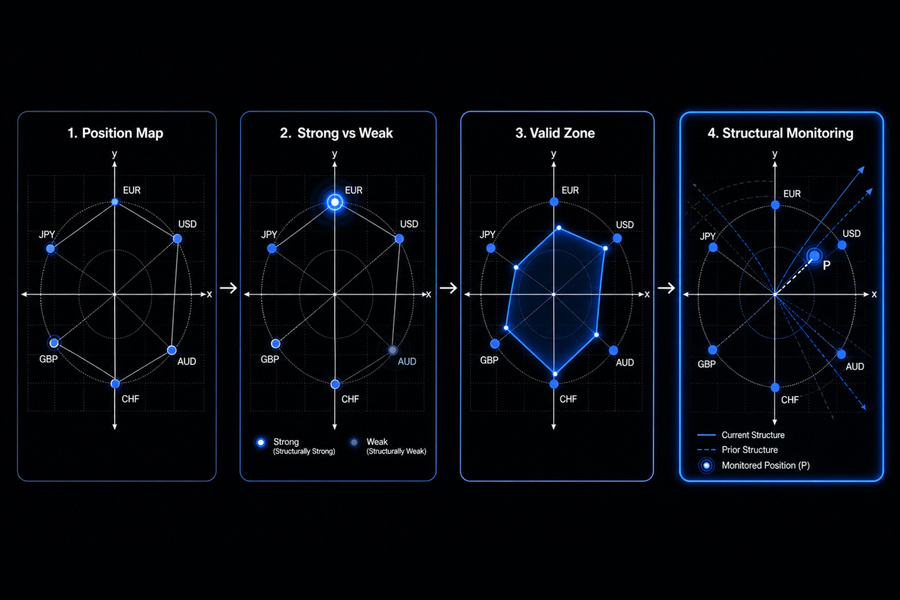
The starting point is not a chart. It is the Cartesian model. You open the jMathFx Platform and you see the current geometric state of the eight major currencies. Each currency is a coordinate position. Each position reflects its current exchange rates against the other seven. You are not looking at price bars. You are looking at the algebraic state of the system.
The first question is structural: which currencies are in geometrically strong positions, and which are in weak ones? This is not the same as asking which currencies are trending. Trend is a time/price concept. Structural strength is a geometric concept. A currency is structurally strong when its coordinate position is algebraically consistent with the positions of the other currencies in the system. It is structurally weak when its position creates geometric tension: when the implied exchange rates do not fully agree across all the pairs it participates in.
From that structural reading, you identify the pairs where the geometric tension is most concentrated. These are pairs where the two currencies involved are pulling in opposite directions in terms of their system-wide positions. A structurally strong currency paired against a structurally weak one creates a clear directional implication that is algebraically derived, not pattern-based.
The next question is about price confidence. Given the current coordinate positions of the two currencies in the pair, which price levels have algebraic support from the full 28-pair system, and which do not? This narrows the space of relevant price levels from an infinite range to a geometrically defined set. You are not looking for support and resistance on a time/price chart. You are reading the algebraic constraints that the system places on the pair from its current state.
Position management then becomes a matter of monitoring the geometric state of the system rather than watching a price bar. If the structural conditions that justified the position remain intact, the position remains intact. If the coordinate positions of the relevant currencies shift in a way that removes the algebraic basis for the trade, you respond to the structural change. You are not managing a stop level. You are managing a position within a geometric framework.
This is what mathematical forex trading looks like in practice. Different from the first step. Different at every step. The jMathFx Platform is built to support this process entirely. Start at jMathFx.com.