
Purchasing power parity is taught in macroeconomics as a long-run tendency. Two economies, two price levels, one exchange rate that should equalize what a unit of currency can buy across borders. Most traders dismiss it as too slow to be useful. That dismissal is a mistake, but not for the reasons usually given.
The reason purchasing power parity matters to a forex trader is not that it predicts when a rate will revert. It is that it defines a structural reference point inside the algebraic system of the market. A currency that has drifted significantly from its purchasing power parity level carries a measurable imbalance. That imbalance is not invisible. It is embedded in the coordinate positions of the affected currencies within the full 28-pair system.
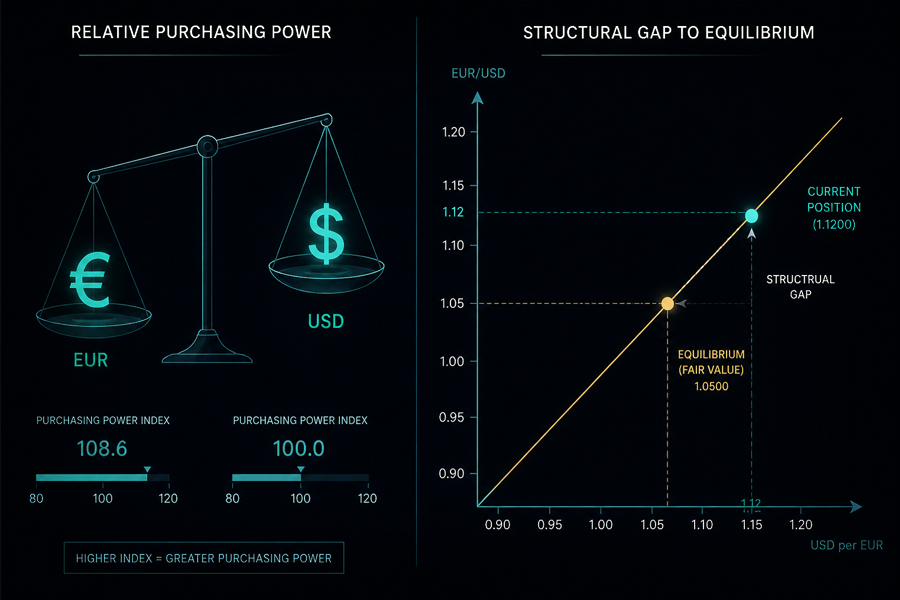
When a currency is overvalued relative to its parity level, its coordinate position on a Cartesian model sits at a distance from where the algebraic structure of the system would place it under equilibrium conditions. That distance is quantifiable. It creates geometric tension across every pair that currency participates in. Not a signal. Not a pattern. A measurable structural imbalance that constrains future movements.
The practical difference between understanding this and ignoring it is significant. A trader looking at a time/price chart of EUR/USD sees a bar moving up or down. They have no information about the purchasing power parity position of the Euro, no way to measure how far the current rate sits from the equilibrium level implied by price levels across the Eurozone and the United States, and no mechanism for understanding what that distance means for the other 13 pairs involving EUR or USD.
A Cartesian model of the market makes that position visible. The coordinate of the Euro in the model reflects its current market valuation. The distance from its parity-implied position is a geometric quantity. The farther that distance, the greater the structural imbalance, and the more constrained the future movement becomes. Not because markets are efficient. Because the algebra of a closed system does not allow imbalances to grow without limit.
Purchasing power parity, understood this way, is not a forecasting tool. It is a structural reference that the algebraic framework of the forex market cannot permanently ignore. The jMathFx Platform maps these structural positions in real time. Start at jMathFx.com.