
Smart Money Concepts have become one of the most discussed frameworks in retail forex trading. Order blocks, fair value gaps, liquidity sweeps, market structure breaks. The terminology is specific, the logic is internally consistent, and the visual presentation on a time/price chart is compelling. There is something right about this framework. There is also something it cannot do, and that limitation matters more than most practitioners acknowledge.
What Smart Money Concepts get right is the observation that price does not move randomly. There are levels where price reacts repeatedly. There are zones where central banks activity concentrates. There are structural shifts that precede sustained directional movement. These observations are real. They reflect genuine properties of the market. The problem is not what Smart Money Concepts observe. The problem is what they cannot explain.
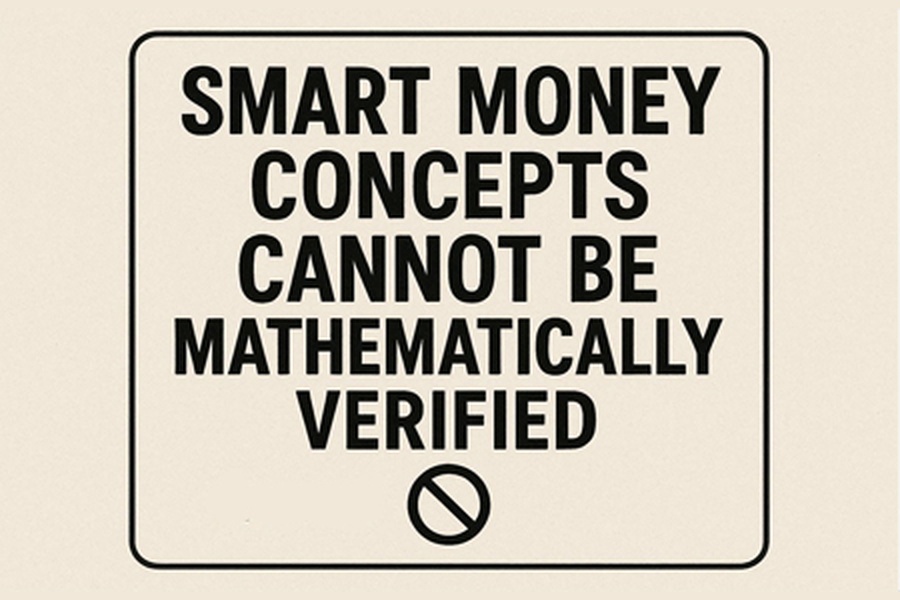
Every concept in this framework is derived from visual observation of time/price charts. Order blocks are identified by looking at price behavior at specific bars. Fair value gaps are measured by eye on a candlestick sequence. Liquidity sweeps are interpreted from price action patterns. None of these identifications can be verified mathematically. There is no formula that produces an order block. There is no algebraic definition of a fair value gap. The framework is descriptive, not derivable. Two practitioners analyzing the same chart will identify different zones, different sweeps, different breaks. This is not a training problem. It is a precision problem inherent to any method built entirely on visual interpretation.
The deeper issue is that Smart Money Concepts, like all time/price analysis, operate on a single pair in isolation. An order block on EUR/USD is identified from EUR/USD data alone. Whether that level is algebraically significant across the full 28-pair system, whether it represents a genuine structural constraint or a local visual artifact, cannot be determined from the time/price chart of one pair. The framework has no mechanism to cross-reference the algebraic state of the entire market. It sees one variable and draws conclusions about a system it cannot observe.
A mathematically grounded approach starts from the other direction. Rather than identifying visual patterns and assigning institutional meaning to them, it maps the algebraic state of all 28 currency pairs simultaneously and identifies the constraints the system must satisfy. When those constraints point to a specific price area, the identification is not visual. It is calculated. It is the same for every practitioner using the same model at the same moment.
jMathFx does not invalidate the intuition behind Smart Money Concepts. It provides what that framework lacks: a mathematical foundation capable of generating verifiable, reproducible analytical output across the full structure of the forex market. The platform maps all 28 pairs on a three-dimensional Cartesian model in real time. What Smart Money describes qualitatively, jMathFx derives algebraically.
If you are already asking the right questions about the market, the next step is finding a framework that can answer them with math rather than interpretation. Start at jMathFx.com.