
Most traders treat EUR/USD as a price. Something that goes up or down based on news, sentiment, central bank decisions, or the pattern on a candlestick chart. This is not wrong. It is just incomplete in a way that costs money.
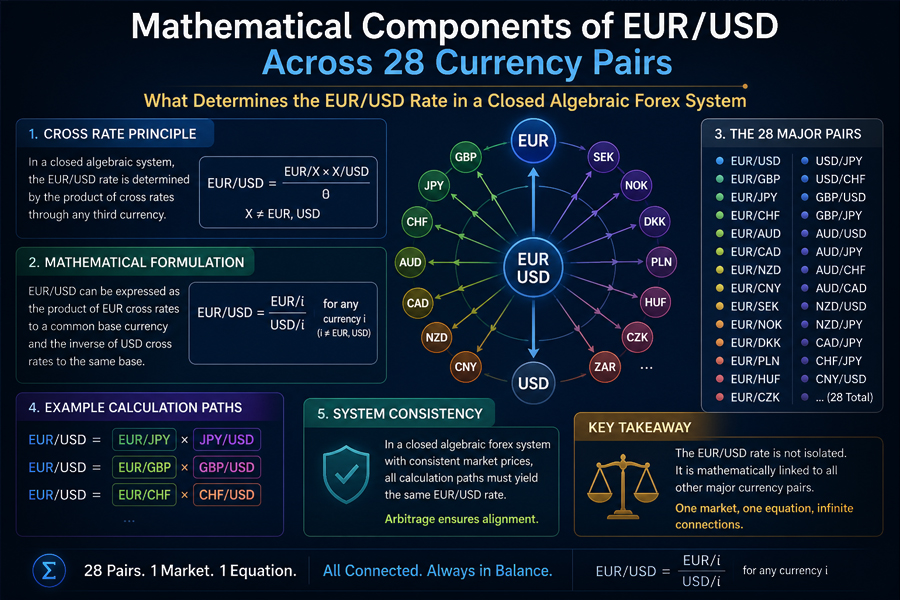
EUR/USD is not an independent price. It is a mathematical result. Specifically, it is the result of the relationship between the Euro and the US Dollar as expressed through every other currency they are both connected to. At any given moment, EUR/USD is determined by the entire network of exchange rates that involve either EUR or USD. Not some of them. All of them.
The simplest version of this is already precise enough to be useful:
EUR/USD = EUR/JPY ÷ USD/JPY
This equation is not an approximation. It is not a model. It is a mathematical identity. If EUR/JPY is 160.00 and USD/JPY is 150.00, then EUR/USD must be 1.0667. Not approximately. Exactly. Any deviation from this figure is an arbitrage opportunity that the market closes in milliseconds. Which means in practice, the equation always holds.
Now extend this logic across all 28 major currency pairs. Every pair involving EUR constrains EUR/USD. Every pair involving USD constrains EUR/USD. The entire structure of the forex market is encoded in every single exchange rate, including the one most traders consider the most straightforward.
This is why analyzing EUR/USD with only an EUR/USD chart is structurally insufficient. The chart shows you the result. It does not show you the algebraic forces producing it. A price bar tells you where EUR/USD closed. It does not tell you whether that closing price is consistent with what CHF/JPY, GBP/USD and AUD/JPY are doing simultaneously. And if it is not consistent, something is about to move to restore the algebraic balance of the system.
That moment, when the system is temporarily out of internal equilibrium, is where mathematically grounded analysis produces its clearest signals. Not because someone predicted a direction, but because the algebra of the market makes certain outcomes necessary.
jMathFx maps the entire set of interdependencies that compose every exchange rate onto a three-dimensional Cartesian model. When you look at EUR/USD inside the jMathFx Platform, you are not looking at a line on a chart. You are looking at a geometric position within a system of 28 algebraically constrained variables. That position tells you things a candlestick chart cannot.
If you want to understand what EUR/USD is actually made of, start at jMathFx.com.