
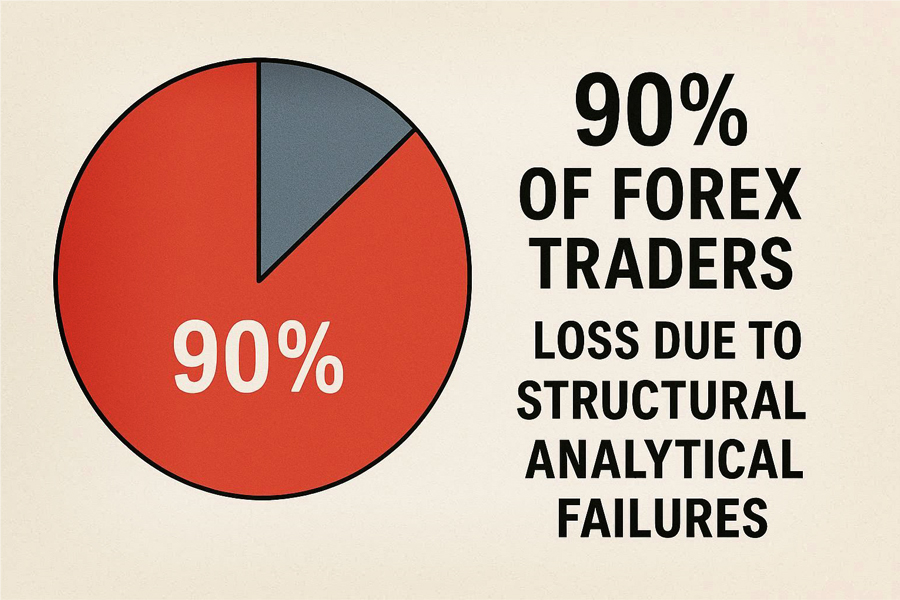
Ninety percent of retail forex traders lose money. This figure has been consistent across brokers, across years, across markets. The trading industry has built an entire narrative around it: traders lose because they lack discipline, because they let emotions drive decisions, because they do not follow their rules. The psychological explanation is everywhere. It is also insufficient.
Psychology does not explain why experienced, disciplined traders with years of screen time continue to produce negative results. It does not explain why systematic traders, who remove emotion entirely from the process, still fail at similar rates. And it does not explain why the failure rate has remained stable for decades despite an enormous industry dedicated to trader education.
The explanation that is almost never discussed is structural. Most traders lose because they are using tools that are incapable of showing them the market they are actually trading. A time/price chart of EUR/USD is not a representation of the forex market. It is a representation of one variable in a 28-variable algebraic system, stripped of all context, stripped of all interdependencies, reduced to a line moving right to left against a timeline. Making decisions from this representation is not a discipline problem. It is an information problem.
Consider what a trader is actually doing when they analyze a single time/price chart. They are observing the outcome of a system they cannot see, looking for patterns in the output while remaining blind to the input. The algebraic forces that produced the price movement they are analyzing, the shifts in other currencies, the propagation of constraints across 28 pairs, the geometric rebalancing of the entire system, none of this is visible on the chart. The trader is not reading the market. The trader is reading a shadow of it.
This is not a problem that better psychology solves. You cannot discipline yourself into seeing information that your tools do not provide. You cannot develop the emotional control necessary to trade correctly from incomplete data, because incomplete data produces incorrect analysis regardless of how calmly you execute it.
The solution is not a better mindset. It is a better model. One that shows the forex market as what it actually is: a closed algebraic system where all 28 currency pairs move in mathematically constrained interdependence. A model where the forces behind a price movement are visible, not hidden. Where the trader calculates from structure rather than guessing from patterns.
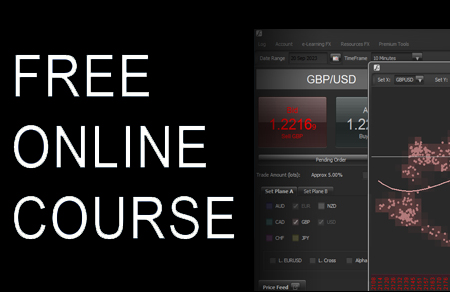
jMathFx was built for this. The platform maps all 28 major currency pairs simultaneously onto a three-dimensional Cartesian model, making the algebraic structure of the market visible in real time. The 90% statistic is not inevitable. It is the predictable result of an industry built on the wrong representation of the market. A different representation produces different results. Explore it at jMathFx.com.