
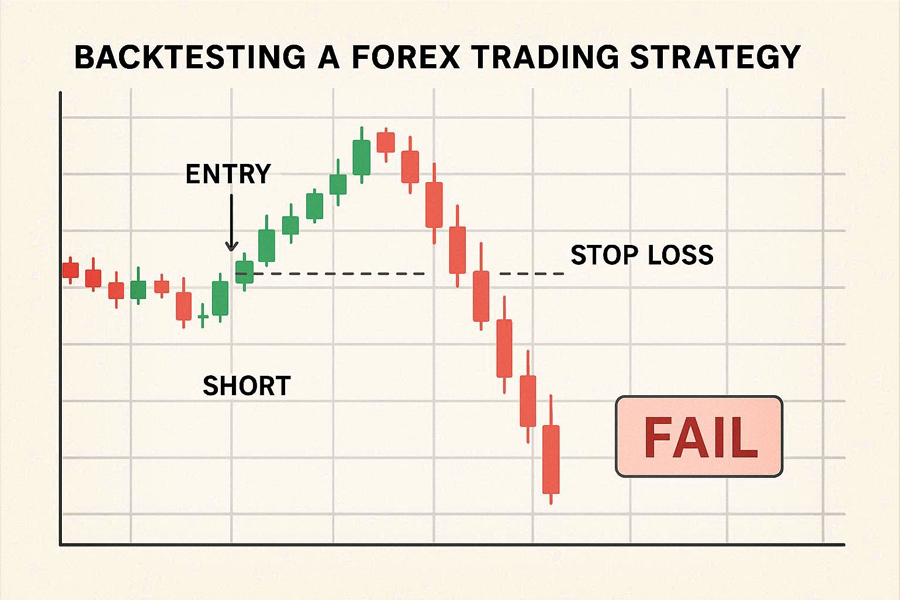
Backtesting is considered a standard step in strategy development. You build a set of rules, apply them to historical time/price data, measure the results, and decide whether the strategy is viable. The logic appears sound. The process is widely taught. It has one fundamental problem that the trading industry rarely discusses openly: backtesting on candlestick data does not test a strategy against the forex market. It tests a strategy against a simplified, single-pair representation of one variable in a 28-variable system.
A candlestick sequence is a record of how one currency pair traded during a series of time intervals. It contains no information about what the other 27 pairs were doing during those same intervals. It contains no information about whether the price movements being tested were driven by the base currency, the quote currency, or a shift propagating from an entirely different pair in the system. It is, structurally, an incomplete dataset. Testing a strategy on incomplete data does not produce an incomplete result. It produces a meaningless one.
This is why strategies that perform well in backtesting fail in live markets at a rate that experienced traders recognize immediately. The failure is attributed to overfitting, to curve fitting, to the psychological pressure of real capital. These explanations are not entirely wrong. But they miss the primary cause: the data used for testing does not represent the market being traded. A time/price chart of EUR/USD in 2020 does not tell you what USD/JPY, EUR/CHF and GBP/AUD were doing simultaneously. It does not tell you what algebraic constraints were active in the system at each moment. A strategy tested without this context is a strategy tested in a vacuum.
The algebraic structure of the forex market means that the same price bar on EUR/USD can represent two entirely different market conditions depending on what the rest of the 28-pair system is doing. A bullish bar produced by genuine Euro strength is not the same event as a bullish bar produced by Dollar weakness propagating from a move in USD/JPY. On the candlestick chart they look identical. In the algebraic system they are categorically different situations requiring categorically different responses.
Validating a strategy requires testing it against a complete representation of the market. Not one pair. Not one timeframe. The full algebraic state of all 28 pairs at every moment being tested. Only then can you determine whether the rules you have built actually capture a structural property of the market or simply fit a visual pattern in a historical sequence of time/price bars.
jMathFx maps the complete algebraic structure of the forex market in real time across all 28 currency pairs simultaneously. The analytical framework it provides is derived from mathematical constraints, not from pattern recognition on time/price charts. This is the difference between a method that can be verified and one that can only be observed. Learn more at jMathFx.com.