
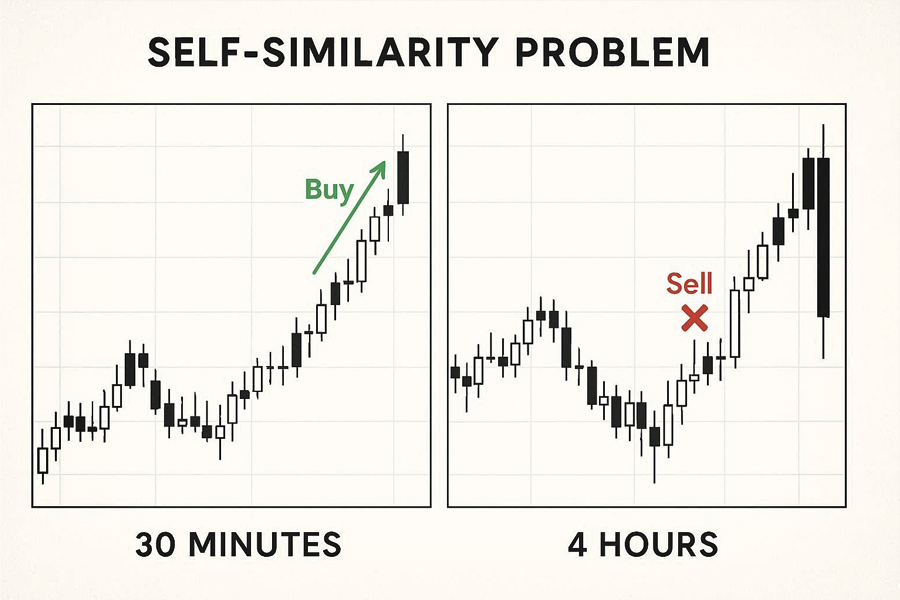
A trader analyzes EUR/USD on a daily time/price chart and reads a clear uptrend. The same trader switches to the four-hour chart and finds a consolidation. On the one-hour chart, the signal is bearish. Three timeframes, three contradictory readings, one market.
This is not a problem of skill or experience. It is a structural property of time/price charts known as self-similarity. Because candlestick charts represent price as a function of time, the same price data produces different visual patterns at different time intervals. The chart does not change because the market changed. It changes because the time interval changed. The market is the same. The tool is producing a different picture of it depending on how you slice the timeline.
Every trader who has spent time trying to align signals across multiple timeframes has encountered this problem. The standard response in trading education is to establish a hierarchy: use the higher timeframe for direction, the lower timeframe for entry. This is a practical workaround. It is not a solution. It does not resolve the fact that a time/price chart has no stable analytical foundation independent of the timeframe chosen. Change the timeframe and you change the conclusion. A method whose output depends on an arbitrary parameter is not a method. It is a preference.
The self-similarity problem exists because the time/price paradigm is the wrong representation for the forex market. Price is not primarily a function of time. It is a function of the algebraic relationships between all currencies in the system. Those relationships do not change when you switch from a daily to an hourly chart. They are constant. They are structural. They are independent of the time interval you choose to observe.
A representation built on the algebraic structure of the market does not have a self-similarity problem because it does not use time as its primary axis. The state of the system at any given moment is defined by the geometric positions of all eight major currencies relative to each other across all 28 pairs. That state is the same whether you are looking at it on a one-minute resolution or a daily resolution. The algebraic structure does not fragment across timeframes. It is always whole.
jMathFx maps this structure onto a three-dimensional Cartesian model. There is no timeframe selection because the model is not built on time. It is built on the mathematical positions of currencies within a closed algebraic system. The signal does not change when you zoom in or out. The constraint is the constraint at every resolution.
If your analysis changes every time you change the timeframe, the problem is not your analysis. It is the paradigm your tool is built on. See what a timeframe-independent model looks like at jMathFx.com.