
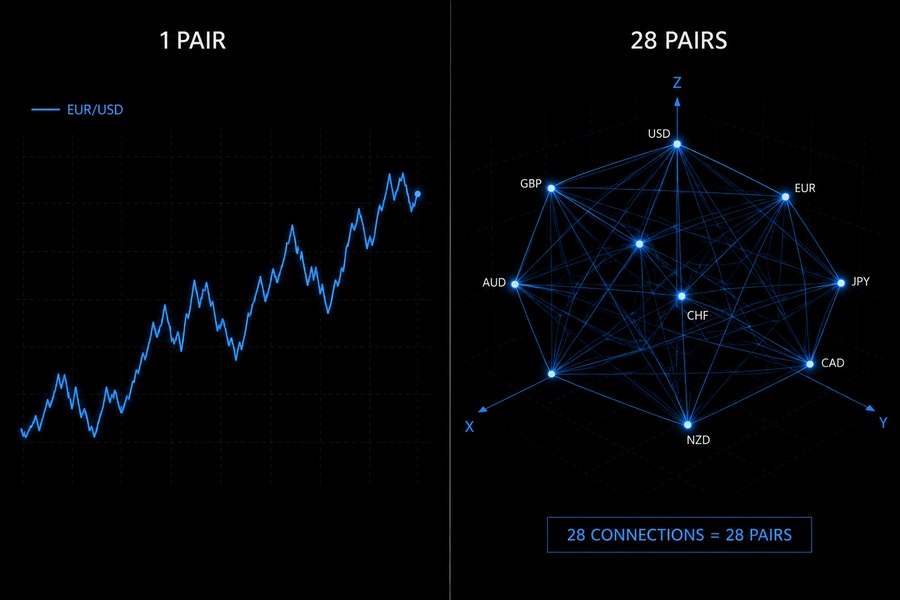
Traders waste hundreds of hours backtesting a single pair in isolation, optimizing indicators, and staring at beautiful, fake profit curves. When they go live, the strategy blows up. They call it bad luck. I call it mathematical illiteracy. A currency pair does not exist in an informational vacuum. You cannot backtest EUR/USD without testing the rest of the network.
A currency pair is not an independent asset. Its value is determined by the relative coordinates of two currencies within a closed network. When you backtest on a single pair, you treat the historical price sequence as if it occurred in an informational vacuum.
You ignore the state of the other 27 currency pairs during that period. You do not see the geometric configurations, the coordinate distances, or the systemic tensions that existed. A parameter configuration that worked on EUR/USD during a period of stability in the Yen will fail completely when the Yen coordinates displace themselves. The historical sequence of a single pair does not contain enough information to capture systemic risk.
To evaluate risk correctly, you must backtest your strategies across the entire coordinate system. You must verify whether your entry and exit rules remain coherent when projected onto the Cartesian plane.
By analyzing historical data as coordinate configurations in the Price Cloud, you can see if your strategy was optimized for a specific, unsustainable market state. This spatial backtesting replaces simple historical curve-fitting with structural validation. Stop testing if a pattern worked in the past. Verify if your rules are consistent with the algebraic constraints of the market.
Related reading: Why Single-Pair Forex Analysis Is Mathematically Wrong