

The efficient market hypothesis says prices move randomly. Decades of academic research have been built on this assumption. Entire trading philosophies depend on it. There is one problem: the forex market is not structured in a way that allows true randomness.
Randomness requires independence. For a price to move randomly, it must be free to take any value without affecting or being affected by other variables in the system. In an equity market, this is at least theoretically possible. Each stock is a separate instrument. Apple and Toyota are not mathematically bound to each other by definition.
Currency pairs are different. Every exchange rate is the mathematical consequence of at least two others. This is not a property that can be switched off during high volatility or suspended during a news event. It is structural. It is permanent. And it makes genuine randomness impossible in the forex market.
Consider what would have to happen for EUR/USD to move randomly. It would have to move independently of the currencies that compose it. But EUR exists simultaneously in EUR/GBP, EUR/CHF, EUR/JPY, EUR/AUD and every other Euro cross. USD exists in GBP/USD, AUD/USD, USD/JPY, USD/CAD and every other Dollar pair. A truly random movement in EUR/USD would create algebraic contradictions across the entire system simultaneously. The market resolves these contradictions in milliseconds. Which means the apparent randomness traders observe on a single chart is not randomness at all. It is the visible surface of a system constantly rebalancing its internal algebraic constraints.
This distinction matters practically. If price movement were truly random, no analytical method would produce consistent results above chance. But the algebraic constraints of the forex market mean that certain price configurations are mathematically impossible and others are mathematically necessary. The market cannot violate its own structure. A trader who can read that structure is not predicting. The trader is calculating.
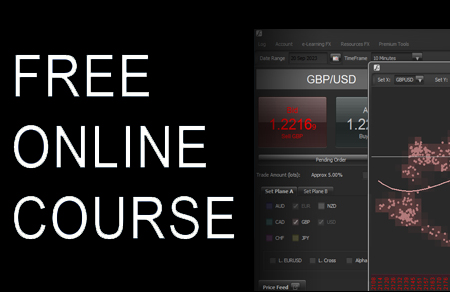
The difficulty is that a standard chart gives you no access to this structure. It shows you one pair, one timeframe, one line. The algebraic system underneath remains invisible. jMathFx was built specifically to expose that system. By mapping all 28 major currency pairs onto a three-dimensional Cartesian model, the platform makes the internal constraints of the forex market readable in real time.
What looks like randomness from inside a single chart looks very different from inside a system. See for yourself at jMathFx.com.