
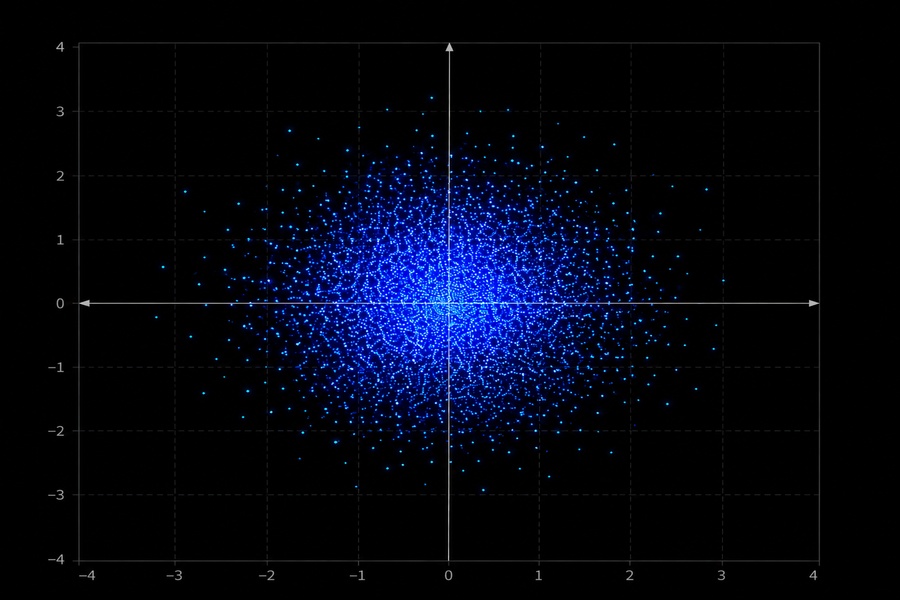
Look at a standard time/price chart. It represents the future as a complete void. It tells you absolutely nothing about where price is allowed to exist. On a coordinate plane, however, the space is populated by historical configurations. This spatial distribution is not uniform. Some regions are dense, while other regions are completely empty. I call these empty regions Price Cloud voids.
When you map currency coordinates on a Cartesian plane, you can calculate the density of the points in any given region. The density represents the frequency with which the market has occupied that specific combination of currency coordinates. Dense areas represent states of stable equilibrium.
Voids are regions that have never been occupied, or have been occupied only briefly during periods of extreme volatility. Mathematically, these voids represent configurations that violate the algebraic balance of the system. The market cannot remain in these coordinates because the resulting tension forces the coordinates to redistribute.
When the coordinates of a currency triad are pushed towards a void, it signals an imminent corrective adjustment. Stop guessing about trend strength or sentiment. You can calculate which coordinate must displace itself to bring the system back into the dense region of the cloud.
Instead of treating trading like a casino, you map these coordinates and calculate the limits. You are dealing with mathematical constraints, not luck. When coordinates enter a void, they must correct. This is the only way to trade with certainty.
Related reading: Price Against Price: The Relational Plane