
Forget the retail broker stories about spreads being simple commissions. In the interbank market, the spread is a dynamic reflection of liquidity and structural equilibrium. When you throw away time-based charts and project currency values onto a Cartesian coordinate system, the spread takes on a precise geometric meaning. I use coordinate geometry to calculate the true distance between transaction points.
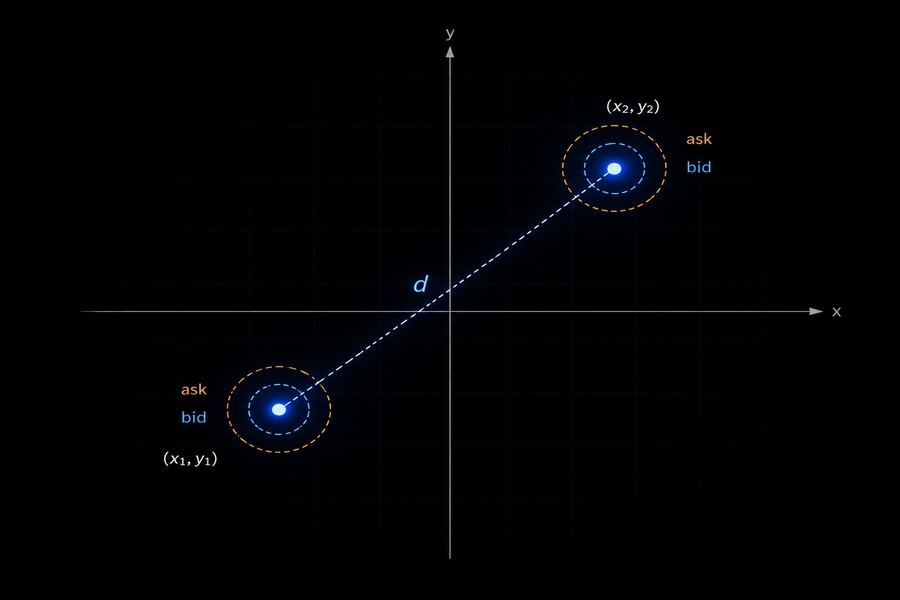
In a relational coordinate system, the distance between two currency coordinate positions is not a metaphorical value. It represents the exchange rate between those currencies. If currency coordinate A is located at (xa, ya) and currency coordinate B is at (xb, yb), the Euclidean distance between them is:
d = √((xb - xa)² + (yb - ya)²)
This distance translates directly to the mid-market price of the currency cross-rate. Because the market operates with distinct buying and selling price levels, each coordinate is surrounded by a boundary of execution limits. The distance between the bid and ask thresholds of these coordinates is the spread. When liquidity decreases, these coordinates shift, changing the spatial distance between the transaction points.
Because the exchange rates must satisfy the closed algebraic system, the spreads of the cross-rates are also constrained. The spread of EUR/JPY cannot expand independently of the spreads of EUR/USD and USD/JPY. The triangle inequality in geometry dictates that the distance between any two points is always less than or equal to the sum of the distances between those points and a third point:
d(AC) ≤ d(AB) + d(BC)
This geometric constraint applies to the transaction costs. If a broker attempts to widen the spread of a cross-rate beyond the algebraic limits of the major pairs, it creates a structural void. Spatial mapping of coordinates makes these anomalies visible, allowing you to identify the most efficient paths of execution and avoid getting ripped off by broker inflation.
Related reading: Cartesian Distance Equals an Exchange Rate