
Brokers sell you leverage as a gift. They tell you that a leverage of 1:500 allows you to control huge positions with a tiny deposit. What they hide is the algebraic constraint that leverage imposes on your account equity. It is not free money. It is a magnification of your exposure.
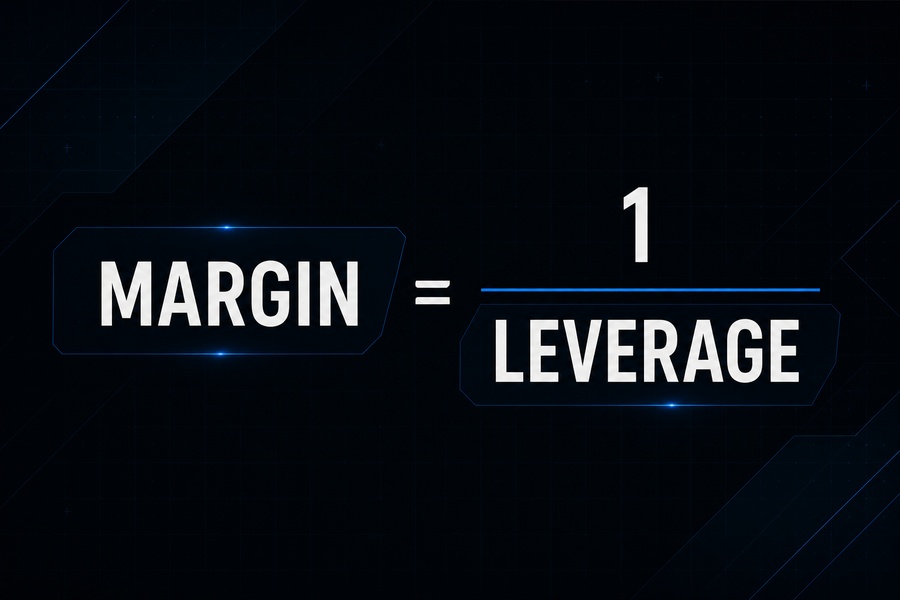
Leverage and margin are reciprocal values. Margin is the required deposit to open a position, expressed as a percentage of the total trade volume. Leverage is the ratio that represents this magnification. The mathematical relationship is:
Margin Requirement = (1 / Leverage) * Position Volume
If you use high leverage, your margin requirement decreases. This allows you to open more positions, but it does not change the risk per pip. The fluctuation of your account equity is determined by the total volume of your positions. If you open five standard lots with a margin of $1,000, each pip movement still changes your equity by $50. High leverage simply allows you to deplete your account faster. It gives you the rope to hang yourself.
To protect your capital, you must view your account margin as a spatial boundary on the Cartesian plane. The coordinates of your open positions move through the Price Cloud, generating floating profits or losses.
If your coordinates approach the margin call threshold, your broker will close your positions automatically. By mapping your margin constraints in coordinate space, you can calculate the maximum displacement your positions can experience before hitting this boundary. I don't use leverage to gamble; I calculate it as a spatial constraint to keep my account within the safety zones of the system.
Related reading: Predicting vs Calculating the Forex Market