
Every indicator in conventional technical analysis works the same way: it observes price history on a single currency pair and extracts a signal from that isolated data. Moving averages, RSI, Bollinger Bands, all of them operate on one pair at a time, with no structural reference to the rest of the market. Predictor works differently. It does not observe one pair. It reads the algebraic state of all 28 currency pairs simultaneously, verifies their mathematical coherence as a system, and produces a price projection based on the equilibrium that system must maintain.
This distinction is not cosmetic. The forex market is not a collection of independent instruments. It is a closed algebraic system. Every cross is mathematically bound to every other cross through the fixed arithmetic relationships between bases. EUR/USD is not independent of EUR/JPY and USD/JPY. It is their ratio. Any projection that ignores this structure is, by definition, incomplete. Predictor does not ignore it. It is built on it.
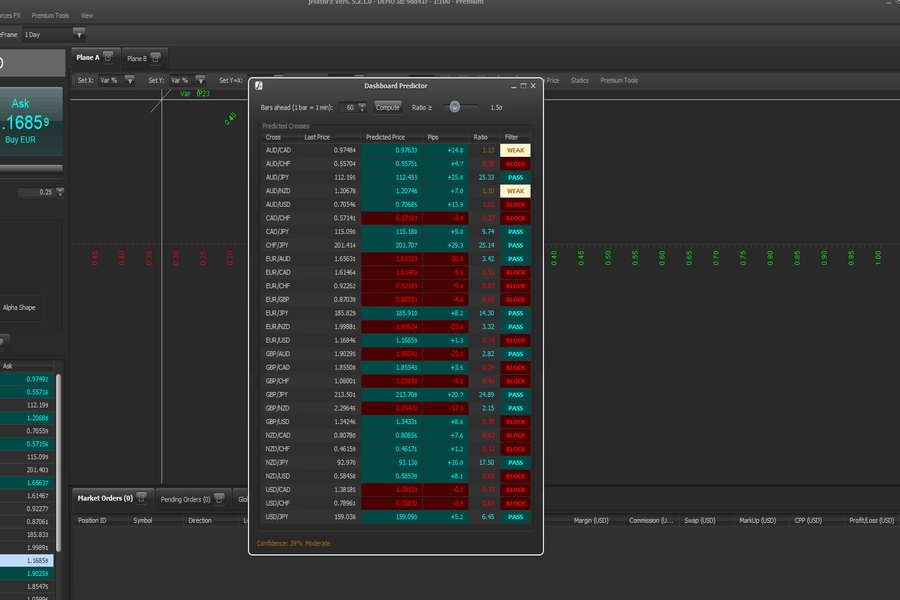
You feed Predictor the most recent prices across the 28 pairs. The algorithm reads that snapshot, calculates the algebraic scenario that best fits the current state of the system, and outputs a projection column showing where each pair is pointed. Alongside the projected prices, Predictor produces a quality score for each signal. That score tells you how confident the algebraic alignment is. A low score means the signal is weak and should be ignored. A high score means the system is in a coherent state and the projection carries structural weight. You decide the threshold. I use values that select only the strongest configurations.
The projections are internally consistent. If Predictor outputs a projected EUR/JPY of 184.07 and a projected USD/JPY of 158.62, then dividing those two figures gives you 1.1601 as the implied EUR/USD projection. Go check the EUR/USD column. It will say 1.1601. That is not a coincidence. That is the algebraic constraint enforced across all 28 outputs simultaneously. No conventional indicator does this, because no conventional indicator knows the other 27 pairs exist.
I ran Predictor against a substantial historical dataset to measure how often the projected price levels were actually reached in intraday trading. The results varied by configuration and time window, but under standard settings the hit rate reached 96% in multiple test sessions. Under broader configurations, sessions came in at 92%, 89%, 85%. These are not cherry-picked numbers from a single favorable day. They are consistent readings across different market dates and different parameter combinations. The accuracy is a consequence of the algebraic structure. The system does not guess. It calculates what the market must do to remain internally consistent, and the market, being a closed algebraic system, tends to do exactly that.
Capital management is the other half of this. Identifying a high-quality Predictor signal is necessary but not sufficient. How much you allocate to that signal determines the shape of your equity curve. That is where the 5% position sizing rule connects directly to Predictor. One selects the operation. The other sizes it correctly against the current balance.
A trader working from a standard time/price chart cannot replicate what Predictor does, because the time/price paradigm does not contain the algebraic relationships between pairs. It shows one pair. Predictor reads all of them. The projection it produces is not a line drawn on a chart. It is the output of a system that treats price as an algebraic variable in a network of 28 simultaneous equations.
The balance history for one of my accounts shows what happens when Predictor signals are combined with disciplined position sizing across a real sequence of live operations. That record is documented and available here.
Predictor is a Premium Tool inside jMathFx. Access it at jMathFx.com.