
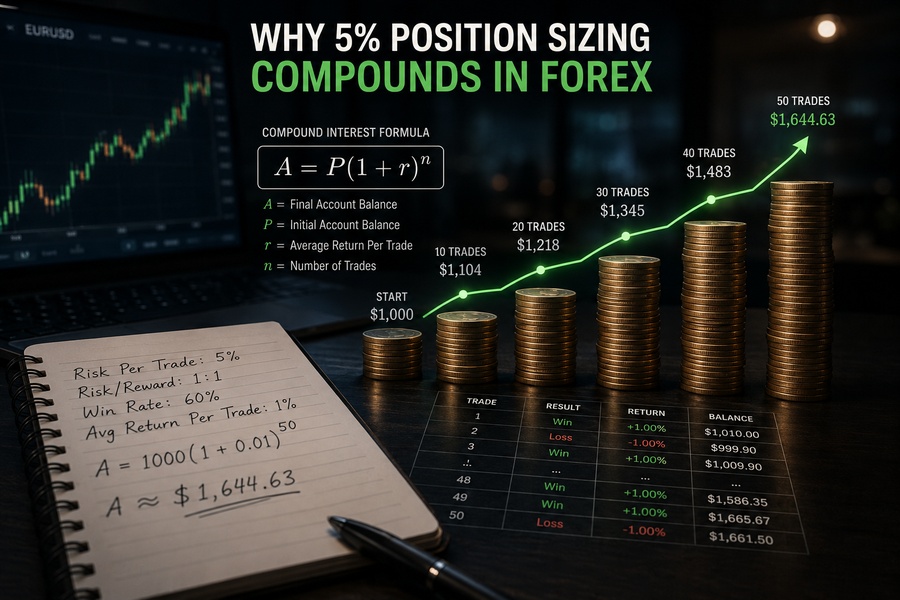
Every time I open a trade, jMathFx automatically allocates exactly 5% of my current account balance. Not 5% of the initial deposit. Of the current balance, updated after every closed trade. This is not a risk management guideline borrowed from some trading book. It is the direct application of compound interest mechanics to position sizing, and the difference between those two framings is everything.
The compound interest formula is A = P x (1 + r)^n. P is the starting capital. r is the return per period. n is the number of periods. A is the final amount. In a savings account, this formula works passively over years. In active trading with jMathFx, the same structure applies across individual operations, and the periods are not months, they are trades.
Take a starting balance of 5,849 USD. The 5% allocation for the first operation is roughly 292 USD. If that trade closes in profit and the balance rises to 5,882 USD, the next 5% is calculated on 5,882 USD, not on the original figure. The absolute size of each position grows with the account. The percentage stays constant. That is the mechanism. Nothing speculative about it. The curve that results is not optimism. It is geometry.
Here is what the progression looks like when the rule is applied consistently across a real sequence of operations:
| Balance milestone (USD) | 5% allocation approx. (USD) |
|---|---|
| 5,849 | 292 |
| 6,367 | 318 |
| 16,971 | 848 |
| 35,534 | 1,776 |
| 52,072 | 2,603 |
| 77,413 | 3,870 |
| 118,492 | 5,924 |
| 146,741 | 7,337 |
Each row in that table is not a projection. It is a recorded balance from a real account. The 5% column shows what the position sizing rule produced at each stage. The amount grows because the base grows. That is compound interest applied to capital allocation in the forex market.
The 5% rule produces exponential results under one condition: the operations it finances must be structurally sound. Allocating 5% of a growing balance to random entries does not produce a compounding curve. It produces a faster version of the same random outcome. The mathematical discipline of position sizing requires a corresponding mathematical discipline in trade selection. That is where the time/price paradigm becomes the bottleneck for any trader trying to apply this rule without an algebraic reading of the market. You cannot compound what you cannot measure consistently.
Inside jMathFx, the 28 currency pairs are treated as a closed algebraic system. The relationships between pairs are fixed by mathematics, not by sentiment. That structural coherence is what makes consistent selection possible. And consistent selection is what the 5% rule needs to produce the curve shown above. To understand how trade selection works at the algorithmic level, the starting point is the Predictor tool and its algebraic projection logic.
A formula applied to a theory is still a theory. A formula applied to a live account, with real capital, across real market conditions, with every trade timestamped and every balance change recorded, is something else. The documented balance history shows the 5% rule in operation from the first trade to the last entry. The curve it produced is not the output of backtesting. It is the output of the formula meeting the market.
If you want to understand the system that generated those results, jMathFx.com is the place to start.