
The retail trading industry is built on a mathematical falsehood. It tells you that price is a function of time. You look at a time/price chart and see a line moving from left to right. You analyze this line with indicators like moving averages, oscillators, and candlestick patterns, expecting the past to predict the future. This is a linear illusion. Price is not a function of time. Price is a spatial relationship. To understand this difference, we must contrast the traditional time/price chart with 3D currency mapping.
A time/price chart displays price as a one-dimensional variable plotted against an independent time axis. Because time is a non-value variable, the slope and angle of the lines on your chart depend entirely on the scale you choose. If you zoom in, the angle changes. If you change the timeframe, the patterns change. A method of analysis that changes its conclusions when you change the scale of the chart is not math. It is a visual illusion.
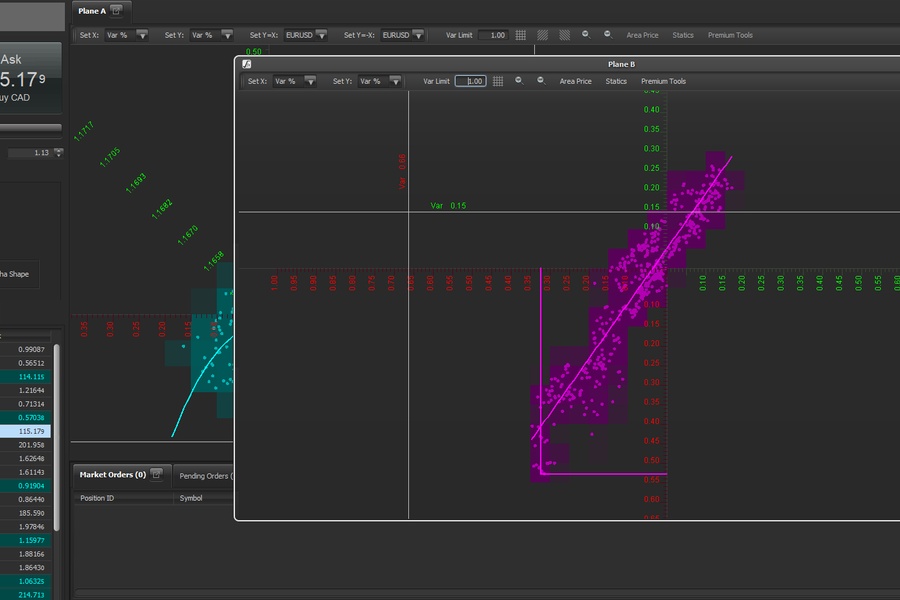
By contrast, 3D currency mapping projects exchange rates as coordinates on a Cartesian plane. In this spatial representation, the X, Y, and Z axes are defined by currency ratios, not time. The position of a currency coordinate represents its value relative to the rest of the network.
This spatial model is scale-invariant. The geometric relationships between the coordinates do not change when you alter the view. The boundaries that constrain the coordinates are defined by the algebraic limits of the market, not by subjective lines drawn on a screen. If the coordinate of a currency approaches the edge of the Price Cloud, it experiences structural resistance that is independent of any timeframe. This boundary is a mathematical invariant, a limit determined by the closed nature of the interbank network. When you trade using these boundaries, you are aligning your positions with the physical limits of the system rather than the arbitrary intervals of a chart.
The mathematical comparison is simple. A time/price chart is a subjective, historical description that changes with your settings. A 3D currency map is an objective, geometric calculation of the current network state. Stop drawing lines on time/price charts. Begin calculating the invariant coordinate structure of the market.
Related reading: What Is 3D Forex Mapping and Why It Changes Everything, 3D Forex Mapping Explained: The Cartesian Approach, Multidimensional Forex Mapping: Seeing All 28 Pairs at Once, How Cartesian Coordinates Transform Forex Analysis, and the fundamental concept of 3D Forex Mapping.