
Retail traders are obsessed with the flat, one-dimensional views provided by the industry. You open a time/price chart, draw a horizontal line, and call it support. You are looking at a single exchange rate in isolation, pretending it exists in a vacuum. This is a severe conceptual error. The currency market is a closed network of 28 pairs, and trying to analyze it through a flat line is like trying to understand the shape of a house by looking at a single brick. I developed 3D Forex mapping to dismantle this flat illusion and expose the spatial structure of the market.
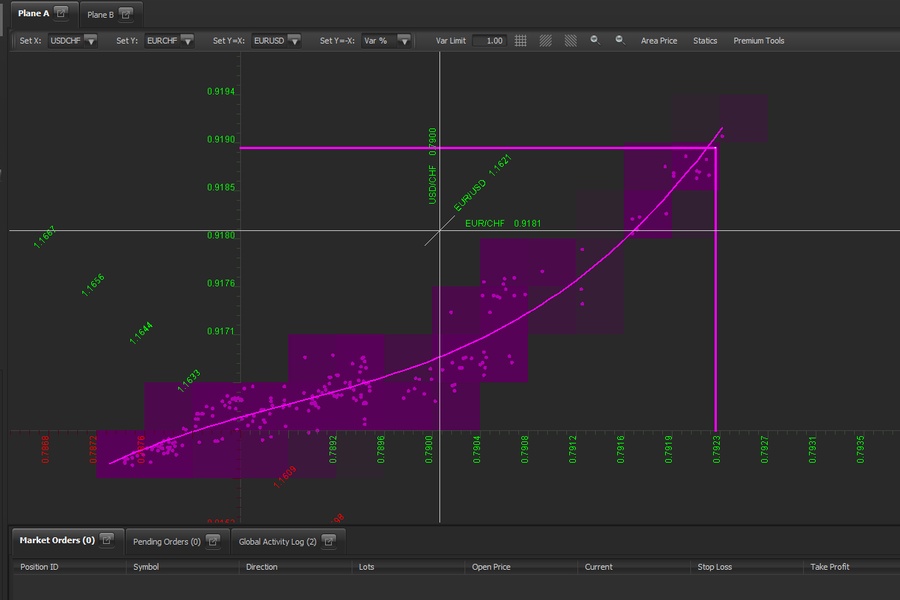
When you look at a single pair, you see a historical path of prices. But when you map the relationships of three currencies simultaneously, you move into a higher dimension. A three-dimensional plane allows you to plot the coordinates of these currencies in space, showing their joint positions at any given moment. This is not about drawing lines on a screen. This is about defining a coexistence space where currency coordinates must align according to mathematical rules.
In this three-dimensional model, the distance between coordinate points represents the cross-rates. Because the market is a closed network, the coordinate positions cannot drift apart arbitrarily. They are bound by strict algebraic boundaries. By observing the point cloud formed by these coordinates, you can see where the market is stable and where it is under stress. If the coordinates move into an empty space at the edge of the cloud, they have entered an exclusion zone. This spatial analysis shows you the limit of the movement before it occurs, because the geometry of the system prevents the coordinates from moving further without a correction.
By transitioning to spatial coordinates, you stop chasing lagging indicators and start observing the actual equilibrium of the system. You are no longer guessing whether a trend will continue based on a visual pattern. You are measuring the physical limits of the coordinate distribution. The entire system is mapped in a single view, replacing subjective analysis with spatial observation. If you want to stop trading blind, you must abandon the flat charts of the retail world.
The traditional software you use is designed to keep you focused on single charts because it benefits the brokers. They want you to execute trades based on panic and visual noise. A three-dimensional perspective changes the entire game. It shifts your role from a gambler trying to predict the next candle to an engineer mapping the equilibrium of a closed network. When you see the coordinates cluster and expand, you are observing the market in its true mathematical form.
Related reading: 3D Forex Mapping Explained: The Cartesian Approach, Multidimensional Forex Mapping: Seeing All 28 Pairs at Once, 3D Currency Mapping vs Candlestick Charts: Math Comparison, How Cartesian Coordinates Transform Forex Analysis, and the fundamental concept of 3D Forex Mapping.