
Look at the screen of a retail trader. You will see six, ten, or twelve different charts open at the same time. The trader is looking from one screen to another, trying to figure out if the movement in EUR/USD is supported by USD/JPY, or if GBP/USD is leading the trend. This multi-screen setup is complete chaos. It is a visual representation of cognitive overload. Your brain cannot process these separate time-series inputs simultaneously. To observe the market, you must use a single multidimensional coordinate system that maps the entire network at once.
In the Forex market, there are eight major currencies that combine to form 28 currency pairs. If you try to analyze these 28 pairs using separate time/price charts, you are trying to solve a puzzle with pieces that are scattered across different rooms. The coordinates of these currencies are not independent. They are bound together in a closed system.
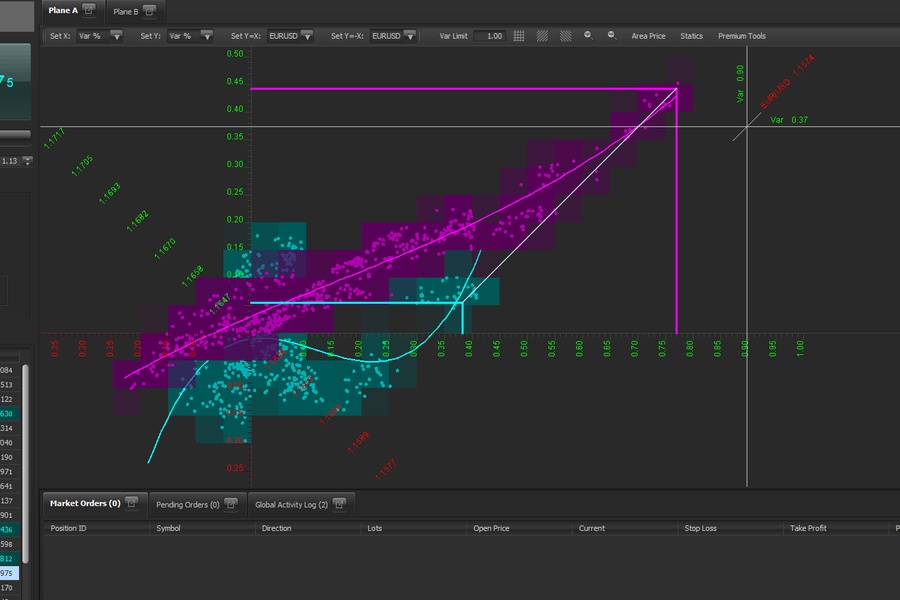
A multidimensional model solves this problem by projecting all 28 pairs on a single Cartesian plane. Instead of tracking price paths over time, we plot the coordinates of each currency relative to a common benchmark. This benchmark acts as the origin of our coordinate system, allowing us to map the displacement of all currencies simultaneously.
When you observe this single plane, the visual chaos disappears. You do not need to look at multiple screens to understand what is happening. If one currency experiences a coordinate shift, you immediately see the corresponding displacement in the other coordinates. The geometry of the plane shows you which currency is driving the market and which coordinates are absorbing the movement.
This multidimensional mapping replaces the fragmented view of the market with a unified perspective. You are no longer trying to connect the dots across different charts. The dots are already connected by the geometry of the plane. You can observe the equilibrium of the entire interbank network in a single glance, allowing you to identify structural deviations before the market corrects them. Stop looking at twelve screens. Start observing the system on a single plane.
Related reading: What Is 3D Forex Mapping and Why It Changes Everything, 3D Forex Mapping Explained: The Cartesian Approach, 3D Currency Mapping vs Candlestick Charts: Math Comparison, How Cartesian Coordinates Transform Forex Analysis, and the fundamental concept of 3D Forex Mapping.