
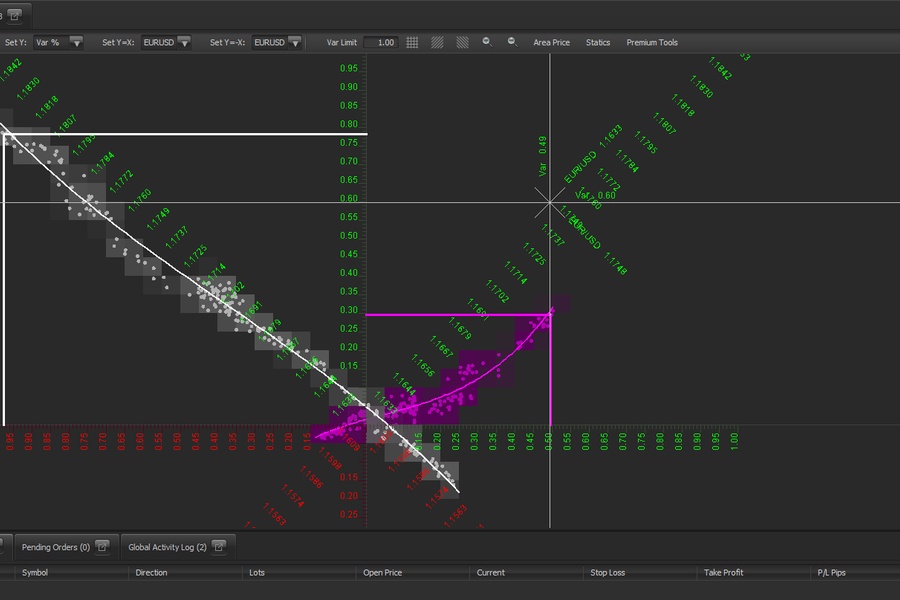
The retail trading world is obsessed with time. You look at one-minute charts, five-minute charts, and hourly charts, trying to find a pattern. This obsession is a trap. Time is a constant that has nothing to do with the value of a currency. A currency is only valuable in relation to another currency. To analyze these relationships objectively, you must remove time and project the exchange rates onto a Cartesian coordinate plane. This is the core of the Cartesian approach to 3D Forex mapping.
By using Cartesian coordinates, we map the relative value of multiple currencies on a three-dimensional grid. Instead of tracking one pair, we define the axes of our coordinate system using three key currency relations. The positions of these currencies are plotted as points in space.
This spatial mapping reveals the structural geometry of the market. In a coordinate system, the relationships between currencies are represented by the spatial distances between their coordinates. Because these currencies exist in a closed network, the points cannot move in isolation. A change in one coordinate requires an immediate, proportional adjustment in the others to maintain the algebraic integrity of the system.
When you observe the market through a Cartesian plane, you are no longer relying on indicators that lag behind the price. You are looking at the live configuration of the network. If the coordinates are pulled too far from their central equilibrium, the spatial distance increases, creating a tension. This tension must be resolved by a corrective movement. The Cartesian approach allows you to calculate these limits and anticipate the correction.
Brokers design the standard time/price chart to keep you looking at the noise. They want you to react to every tick. The Cartesian grid, however, replaces subjective visual analysis with precise geometric calculation. You do not look for head-and-shoulders patterns or moving average crossovers. You measure the coordinate positions and calculate the boundaries. This is the only way to analyze the market without the noise of the time/price chart.
Related reading: What Is 3D Forex Mapping and Why It Changes Everything, Multidimensional Forex Mapping: Seeing All 28 Pairs at Once, 3D Currency Mapping vs Candlestick Charts: Math Comparison, How Cartesian Coordinates Transform Forex Analysis, and the fundamental concept of 3D Forex Mapping.