
The retail trading industry wants you to treat currency pairs as isolated financial assets. You open your charts, draw some subjective lines, and make a bet. Then you open another pair and do the same. This is a mathematical absurdity. You cannot trade currencies in isolation because they do not exist in isolation. I built my platform on a simple truth: the market is a single, interconnected network.
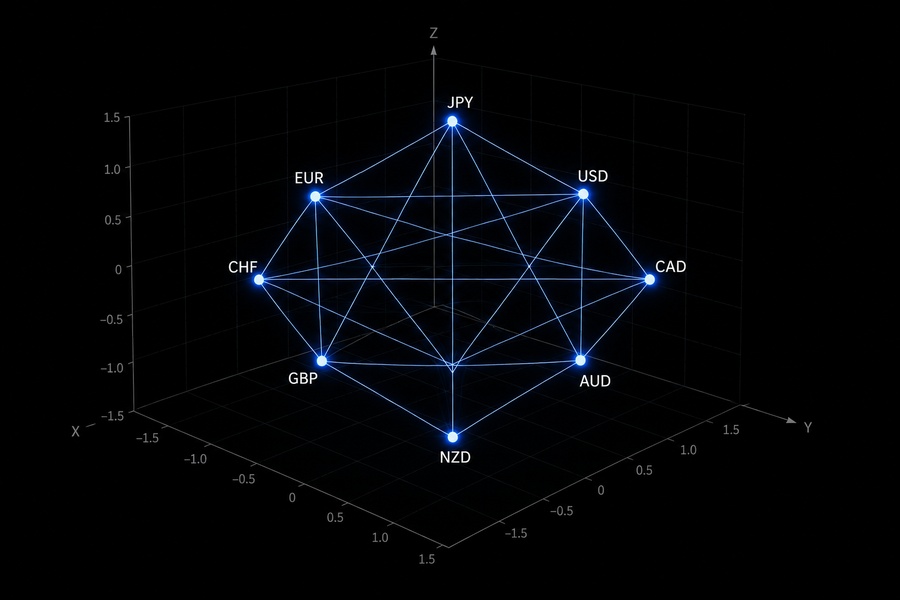
A currency pair is not a standalone asset. It is a ratio of reciprocity between two monetary entities. In a market composed of eight major currencies, there are 28 currency pairs. These 28 exchange rates are not independent variables. They are mathematically linked by algebraic constraints.
If you know the exchange rate of EUR/USD and USD/JPY, the exchange rate of EUR/JPY is already mathematically determined. This relationship can be expressed by the basic triad formula:
EUR/JPY = (EUR/USD) * (USD/JPY)
Any deviation from this equation would immediately create a risk-free arbitrage opportunity. Because modern institutional algorithms scan the interbank market continuously, such deviations are resolved in milliseconds. The 28 currency pairs exist in a closed algebraic system where no single rate can move without triggering a compensatory adjustment across the entire network. If you trade one, you are trading the geometry of all of them.
I designed the jMathFx Platform to make these algebraic relationships visible. Instead of plotting a single exchange rate over time, my platform projects the coordinate values of multiple currencies on a Cartesian plane.
By representing currency values as coordinates in space, I eliminate the need for time-based indicators. The geometry of the plane shows you the true structural relationships. If three currencies form a triangle on the plane, the lengths of the sides of that triangle correspond to the cross-rates. The geometry of the system imposes hard limits on the possible configurations of exchange rates.
This spatial model allows you to identify when the system is in equilibrium and when it is experiencing structural tension. A tension in one currency pair must be resolved by a displacement in other coordinates. You are no longer predicting where a single pair will go. You are calculating the necessary path the system must take to restore equilibrium.
Related reading: Learn more about this spatial model in What Is 3D Forex Mapping and Why It Changes Everything, explore the geometry in 3D Forex Mapping Explained: The Cartesian Approach, see the network in Multidimensional Forex Mapping: Seeing All 28 Pairs at Once, study the comparison in 3D Currency Mapping vs Candlestick Charts: Math Comparison, and discover how coordinates work in How Cartesian Coordinates Transform Forex Analysis.